 |
ENSIGN |
|
1
Grahame N's Web Pages
9.5MM
ENSIGN
"UNIVERSAL"
CINE PROJECTOR
by Grahame L. Newnham
|
ENSIGN |
|
.There's little I know about the Ensign company, except that as a company Ensign arrived in 1930, although I believe Houghtons had used the name 'Ensign' on some of their cameras in the 1920s or so. With a factory at Walthamstow, London, Ensign produced many still cameras, a range of 16mm cine projectors and the well-know 16mm Ensign 'Kinecam' cine camera - all before the Second World War. On the nights of 24th and 25th September 1940 enemy bombing destroyed their head office Ensign House in High Holborn, London. The factory also suffered bomb damage. After the war, with the factory rebuilt, they merged with a well known British lens company and became Ross-Ensign Ltd. continuing with a good range of still cameras and various photographic accessories which still included excellent film splicers and rewinders. Sadly, with the rash of imported photographic products, they went under around 1960. I believe there is a sad story about their chief optical designer who hearing the news, rushed into the plating shop and drank some Potassium Cyanide! Not a nice way to end it all! Anyhow, I have 'pinched' a full history of the company from the internet - see below:-
Claudet & Houghton
was founded in 1834 by George Houghton and Antoine Claudet, and
subsequently underwent several mergers that resulted in numerous
name changes.
- When the company merged with Holmes
Bros., A.C. Jackson,
Spratt Bros.
and Joseph Levi & Co.
in 1904, the business became Houghton’s
Ltd. - The company was known as George
Houghton & Son (1867-1892), then as George
Houghton & Sons until 1903, and then George
Houghton & Sons Ltd.
- In 1915, after establishing a partnership with W.Butcher
& Sons Ltd., the company traded as Houghton
– Butcher Manufacturing Co. Ltd. until
1926, when the name was changed to Houghton
– Butcher (Great Britain) Ltd.
- In 1930 the business was renamed again, this time as Ensign,
after their most successful line of cameras. Interestingly, the
Ensign name derived from the 'N' sign logo-
After a later merger with Elliot
& Sons Ltd. in 1945 the company became Barnet
Ensign Ltd.
- After another merger with Ross,
the company became Barnet Ensign Ross Ltd.
in 1948.
- Finally, in 1954 the name was changed for the last time, to Ross
– Ensign Ltd. The company discontinued
the manufacture of still cameras, and was dissolved, in 1961.
ENSIGN UNIVERSAL CINE PROJECTOR - UK - approx 1938/39 - 1940

Ensign 'Universal' advert around 1939

Advert in the UK Amateur Cine World magazine - November 1939
(really not the best time to introduce a nice new cine
projector!)
Their first (and only) excursion into the 9.5mm projector market was in 1939, when Ensign launched the 'Universal' cine projector. A quick glance suggests it could be mistaken for a Bolex 'P' or 'D' series - it had the same indirect lighting system, with the lamphouse at the side and a mirror reflector for the light. The 400 foot / 120 metre spool capacity was probably the best the compact design could accomodate, but many 16mm users would have wanted 800 foot spool capacity.

It is easier to quote from the late Gerald McKee's useful book 'The Home Cinema - Classic Home Movie Projectors 1922 - 1940' :-
"Ensign waited about a year before introducing a completely new projector., the 'Universal', launching it in 1939. Of course, as events turned out (with the declaration of war coinciding with the appearance of the Ensign 'Universal' in the photographic dealers) this was unfortunate timing. Nevertheless, this attempt at manufacturing the first multi-gauge projector in England was an important move.
The most noticeable feature of the new 'Universal' was that it adopted the 'reflected light / single sprocket' layout successfully used by Kodak on their Kodascoper 'C' and 'D' and by Pailllard on the Bolex 'PA' and 'DA', all of which were outmoded by 1939. But Ensign used this design to give the 'Universal' a similar appearance to these other models. In the way as the Bolex 'G' series, the 'Universal' came in combinations of two gauges 16/9.5mm, 16/8mm and 9.5/8mm, as well as the tri-gauge version. All these machines were supplied with either a 250watt or 500watt lamp, and Dallmeyer 'Superlite' lenses were available in focal lengths of 1 inch, 1.5 inch, or 2 inch.
Everything has been well thought out. There were two sets of self-centering sprocket guides on the single sprocket, moved into position by sliding catches. The lens and front part of the gate swing forward for threading and cleaning. It had grouped controls in the front; separate mains and lamp switches, a lever to select forward, neutral (stills) and reverse, and the speed control knob. Built into the base, and illuminating these switches was a pilot light. The upper part of the lamphouse hinged backwards to aid lamp changes.
The 'Universal' had a shutter giving three obscuarations per frame, optical framing and an unusual drive; the motor coupled to the mechanism by a friction wheel instead of a rubber belt (an arrangement used in some Super 8 projectors of more recent vintage). Attractively finished in bronze wrinkle enamel, the compact 'Universal' avoided the clumsy appearance of the solidly built Silent Sixteen series, it was definitely more stylish.
In 1940, the Houghton Butcher factory became a war casualty when it was bombed. Production of the projector ceased and the Ensign film library was disbanded. After the war the Walthamstow factory was rebuilt, but there was no post-war production of movie cameras or cine projectors. For a while, Ensign still manufactured their excellent range of movie accessories including the 'Popular' splicer and rewind bench for both 9.5mm and 16mm; and the well known 'Universal' splicer for all three gauges. "
' .
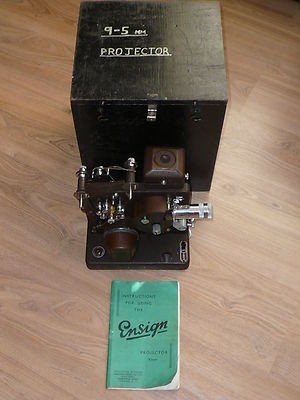
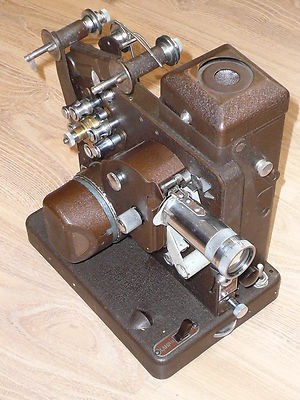
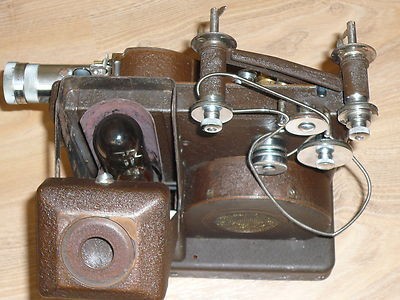
Ensign 'Universal' - lamphouse open
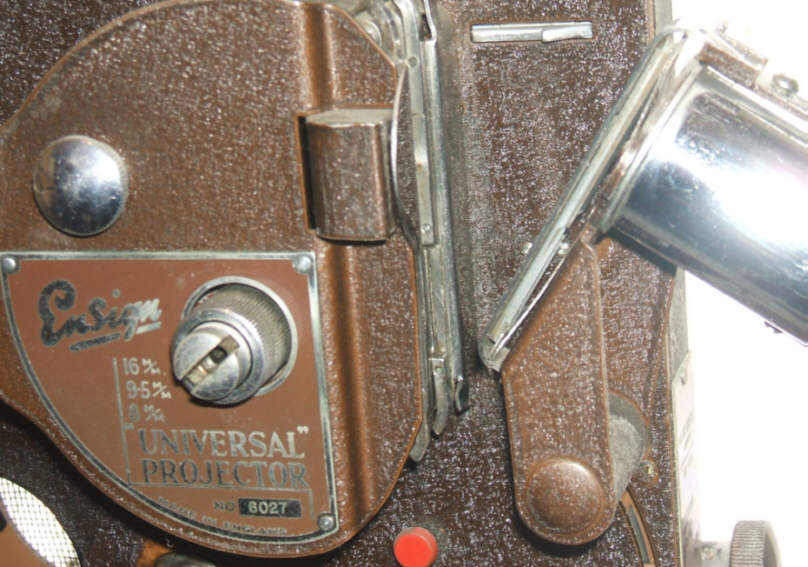
Ensign 'Universal' - film gate open
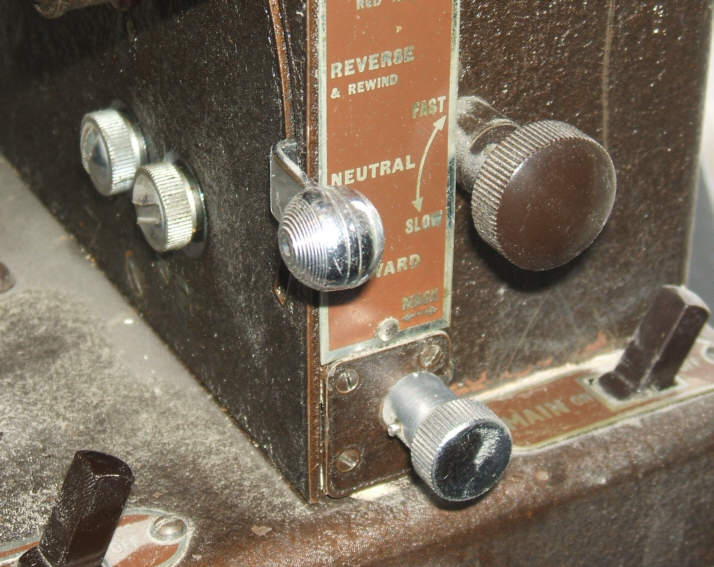
Ensign 'Universal' front controls
It's important to remember that this machine runs on 110volts; normally it was supplied with a dropper resistance for the normal UK main supply - there are adjustable settings for the 50 volt 250 watt and the 100 volt 500 watt pre-focus lamps. A luxury is the proper transformer - this cut out lost heat (and energy) and was a good deal safer than those dreaded dropper resistances! The machine was marketed in 8mm; 9.5mm; and 16mm film gauges, as 'Single', 'Dual' or 'Triple' gauge. The extra parts could be purchased, so that one could upgrade from any model to the full triple gauge version. A handle was supplied for hand cranking the machine in areas where there was no mains supply. A 12 volt 72 watt lamp was then supplied to run from an accumulator.
Gauge change is quite staightforward for 9.5mm to 16mm and vice-versa - spool spindles, gate front runners and sprocket change is all that is needed, but in addition for 8mm a change of condenser lens and the claw cam drive is required. The machine will run forwards or reverse; it's also possible to project still frames. The motor is a series wound variable speed type with rotary speed control on the front of the projector body. A pilot lamp is fitted so that one can check all is well whilst the machine is running - this is controlled from a toggle switch at the rear of the machine - perhaps this was an afterthought as it is a standard metal toggle switch, whilst the motor and lamp switches at the front have brown bakelite toggles.
A rather modern feature for 1939 is an earthing terminal adjacent to the input socket ' for earthing the machine where desirable' the instruction book says!
The Ensign 'Universal' was fully reviewed in the September 1939 edition of the Amateur Cine World magazine.

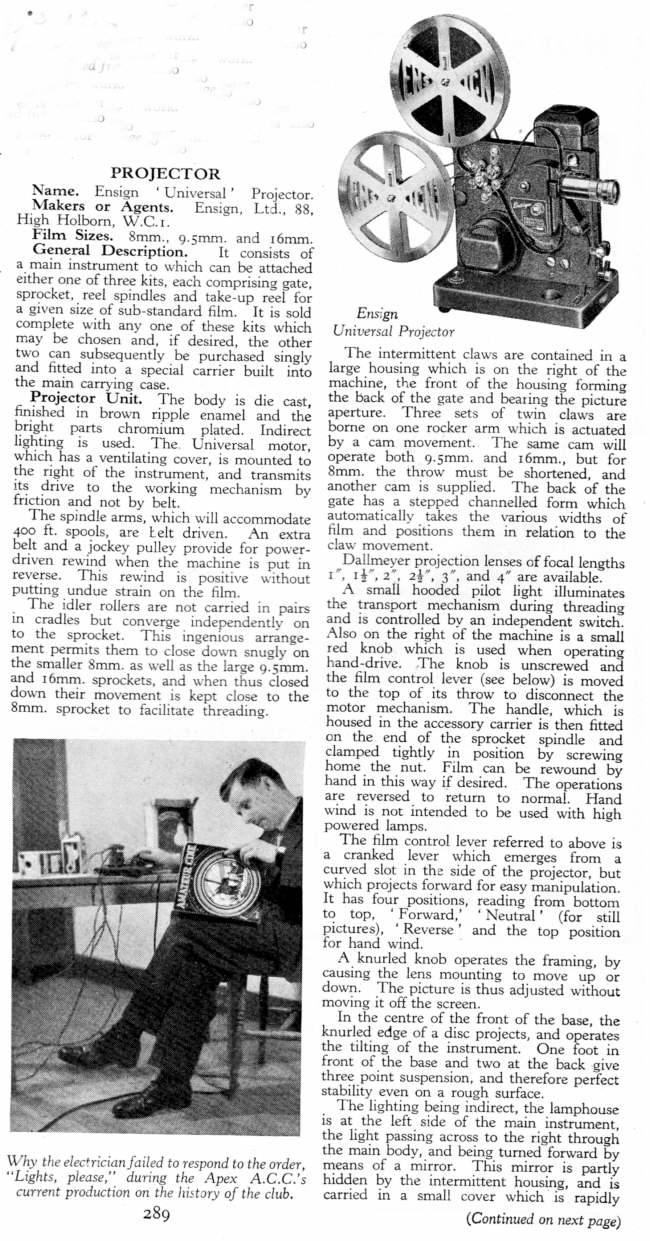
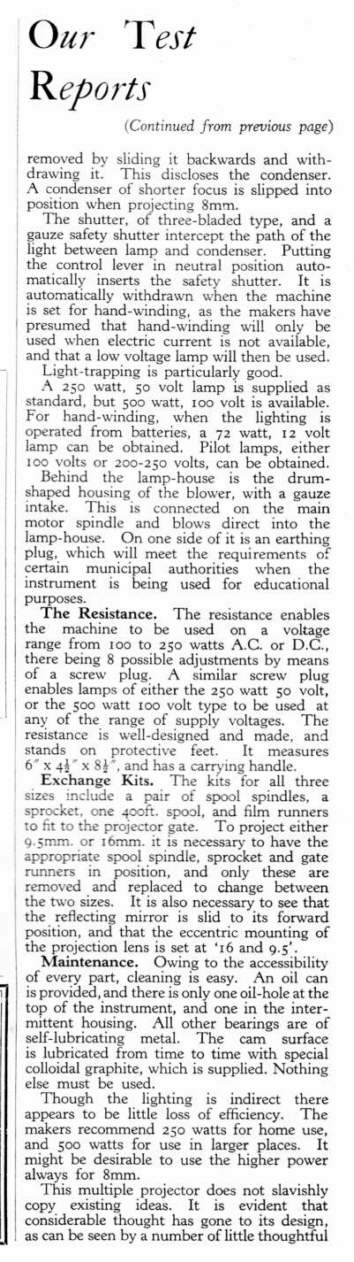
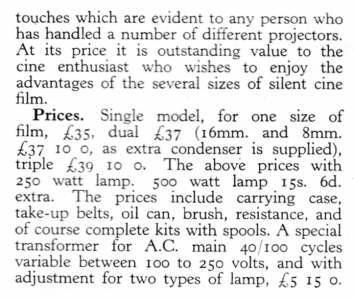
Amateur Cine World magazine Sep1939 review
ENSIGN CINE ACCESSORIES - UK - 1935 - 1961

Ensign advertisement circa
1937
In the 1930s Ensign produced a range of cine accessories including two types of cine film splicer - a multi-gauge rather complicated design and a simpler, easy to use single gauge model. Production continued well up to the demise of Ross-Ensign in 1961. In fact Wallace Heaton obtained the final stocks, and I purchased a 9.5mm Ross-Ensign 'Junior' splicer for the princely sum of 9/6d (45p) brand new and boxed, when they had been on the market at £2 or £3! I used that splicer for many years until I upgraded to a Marguet tri-gauge when in my later teens I began using both 8mm and 16mm as well as 9.5mm. Ensign also produced a film rewinder - single gauge or 'Universal' which had interchangeable heads for 8mm / 9.5mm /16mm. There was also Ensign 'Universal' film cement, a range of chemicals, cine screens and Ensign cine spools - I have seen these as 200 foot / 60 metre and 400 foot / 120 metre 9.5mm and 16mm.

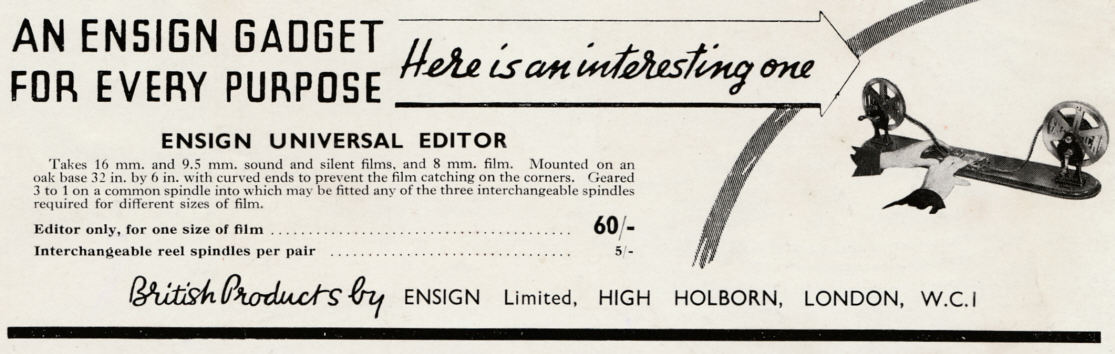
Amateur Cine World movie magazine advert March 1940
ENSIGN PRINTED FILMS - UK - 1935? - 1940
Also, sometime during the later 1930s Ensign produced a range of printed films, initially in 16mm, mostly 100 foot / 30 metre releases called 'Ensignreels'. Later they also issued 8mm 50 foot / 15 metre versions, but they didn't venture into 9.5mm. So if you do come across a 9.5mm 'Ensignreel' it will be a reperf.! Seems, whilst Pathéscope had done a deal with Walt Disney for 9.5mm releases, Ensign managed to clinch a deal for 8mm and 16mm releases. But they were never full length, just the 4 minute cut-downs.
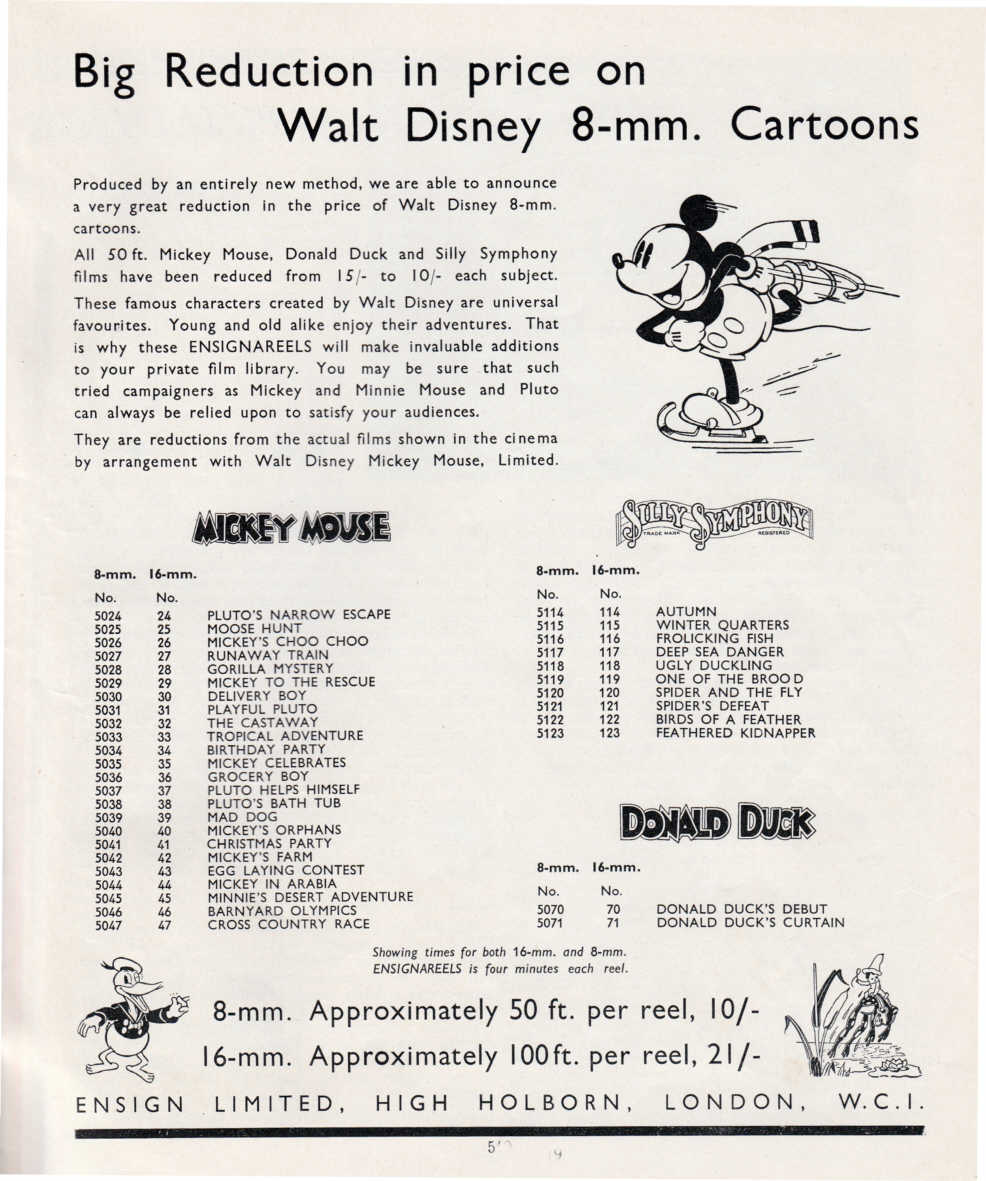
Amateur Cine World magazine January 1939 advert
Return to: 9.5 EQUIPMENT PAGE ............ or NINEFIVE MENU ............ or return to MAIN MENU
Created 11Jun2019 ............ Last updated: 13 October 2019
..................... 95gearensign.htm .................. ©
Grahame L. Newnham's web pages MMX1X
27Jun2019 - Ensignreel printed films added / 6Jul2019 ACW
Sept1939 review added / 12Oct2019 - ACW Nov39 advert added