9.5MM
CINE CAMERAS & PROJECTORS

Grahame N's Web Pages
DEKKO
9.5MM
CINE CAMERAS & PROJECTORS
Dekko seems to have begun in 1934 as Dekko Cameras Ltd
with the advertised address as - Slough, Bucks, UK - London
Depot: 17, Thavies Inn, London E.C.1
after 1938, their advertisements announced their address as - :
Dekko Cameras Ltd., Telford Way, East Acton, London, W3, UK
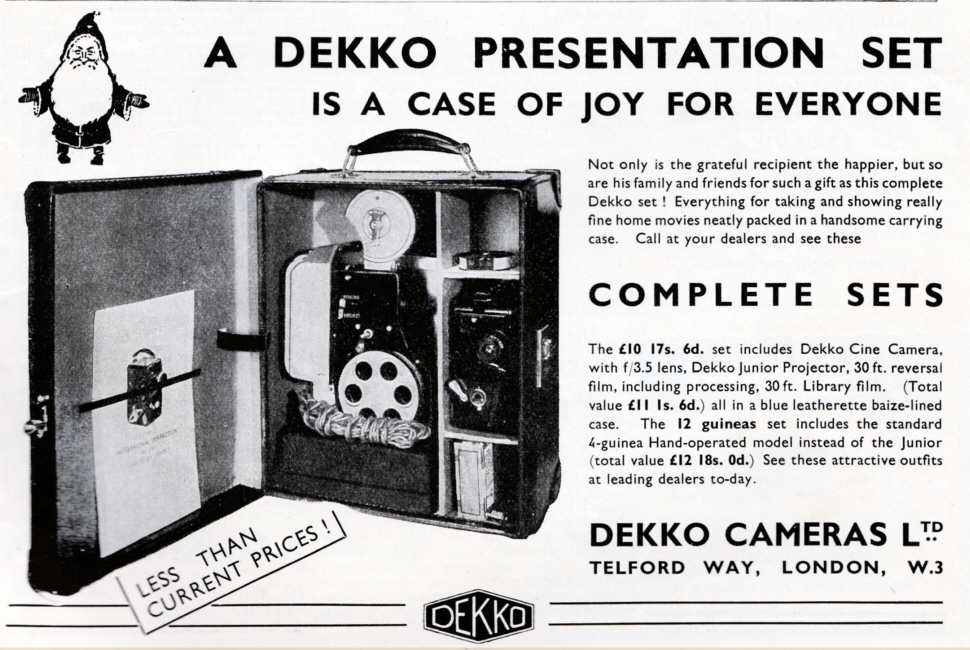
Dekko advertisement in the Amateur Cine World
magazine dated January 1939
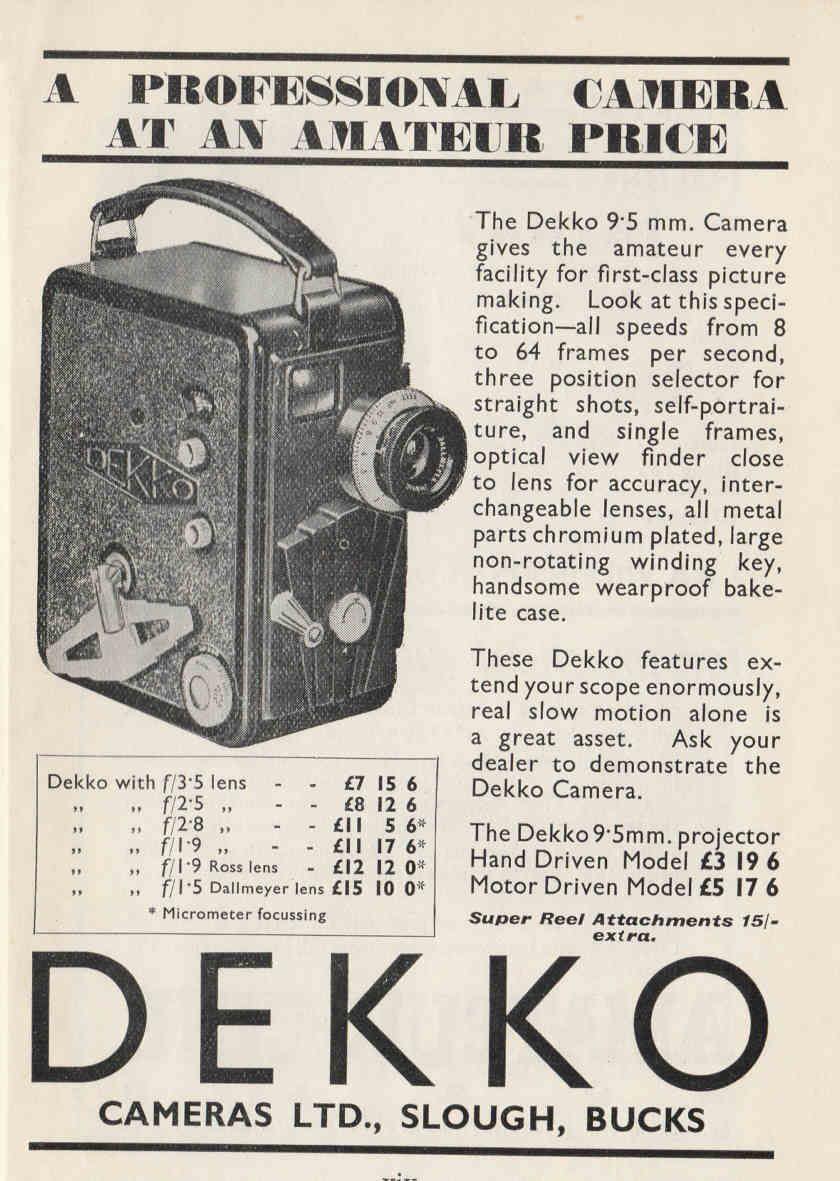
Advert in Harold Abbott's 1937 book 'The Complete
Amateur Cinematographer'
ORIGINAL DEKKO 9.5MM CINE CAMERA. (1934 - 1939) - Typical serial number 6654
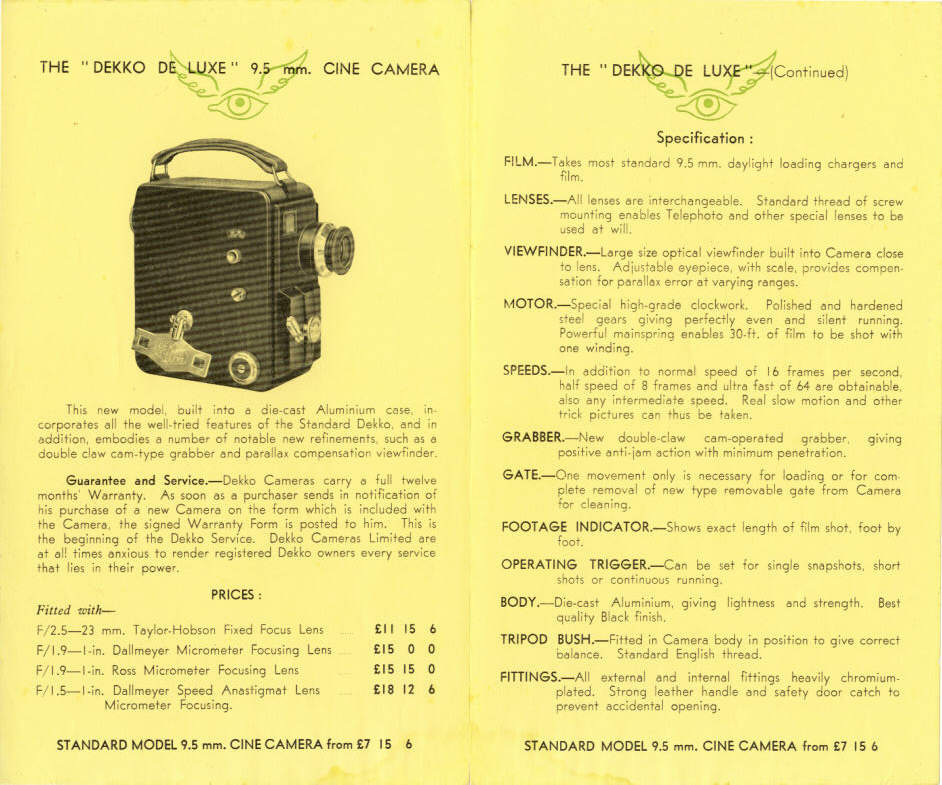
9.5mm Dekko cine camera leaflet (really for the
later metal bodied model 104, but photo shows original bakelite
camera!)
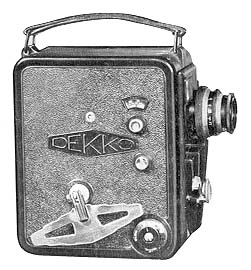
The first advertised product from Dekko was a 9.5mm cine camera - this was well publisised in cine magazines. Announced in 1934, this model seems to have been marketed right up to 1939.
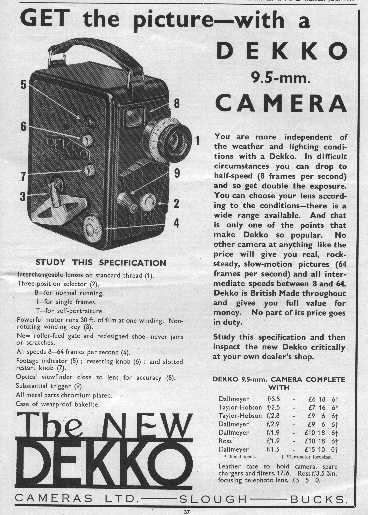
The 'new' Dekko 9.5mm cine camera was well
advertised
This first model cine camera has an art deco styled black bakelite body, size 5 x 4.25 x 2.25 inch, with chromium plated controls. It has a long running clockwork motor with a decent size folding winding key. On the side there is an inching knob, a footage counter and a variable filming speed adjuster with speeds from 8 to 64 frames/second. The top has a leather carry strap and on the base is a standard 1/4inch tripod bush. The front carries the push down release lever and a knob providing still picture, normal filming and lock-on run. The inter-changeable lens mount is a 16mm type 'C' - with a good range of lenses from Dallmeyer and Ross offered. The camera was normally supplied with an f2.5 fixed focus 23mm focal length lens or f1.9 focussing lens of 25mm / 1inch focal length. In the Dekko advertisements, the lens choice also included an f3.5 fixed focus 20mm focal legth and an f2.8 or f1.5 micrometer focussing lens. The viewfinder is marked for 75mm / 3 inch and 50mm / 2 inch telephoto lenses. The camera door opening button on the rear of the camera can be screwed up to prevent accidental opening.
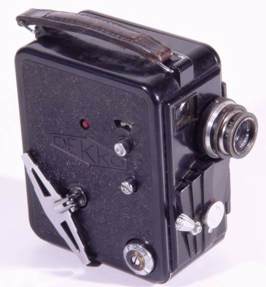
The 1934 Dekko 9.5mm cine camera
I myself bought one of these when I was about thirteen years old - from a secondhand shop, Mortons, near Fratton Bridge in Portsmouth. He was asking £5, but when I handed over my money, he gave me my ten shilllings depoait back and a charger of camera film! I also had a 9.5mm Pathéscope 'Prince' cine camera, bought new at half-price for my by my Dad for a birthday or Christmas present; the 'Prince' was great - gave good results and looked modern, but it had a fixed focus lens. As the Dekko had an f1.9 focussing lens I was able to use it filming titles, and indoors with photofloods It was designed to take the 'P' tyoe film chargers, but could also accept the neater 'H' type film charger.
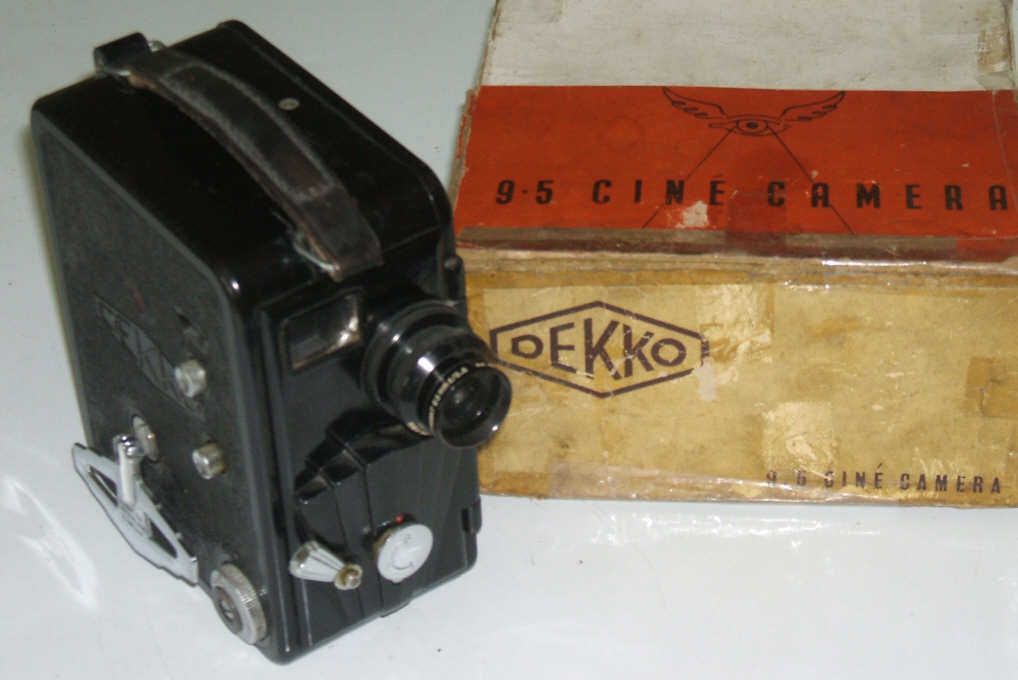
f2.5 fixed focus lens on this example in my
collection
As the late Gerald McKee says in his excellent book - "The Home Cinema - Classic Home Movie Projectors 1922 - 1940" - "Dekko had their chief claim to fame for their excellent 9.5mm camera. Modern in concept (it had a plastic bakelite body) with facilities required by the intelligent amateur ( a 'C' mount lens and variable speeds from 8 to 64 f.p.s.), it was well ahead of Pathéscope's cameras in its thoughtful design; it was all-British too!"
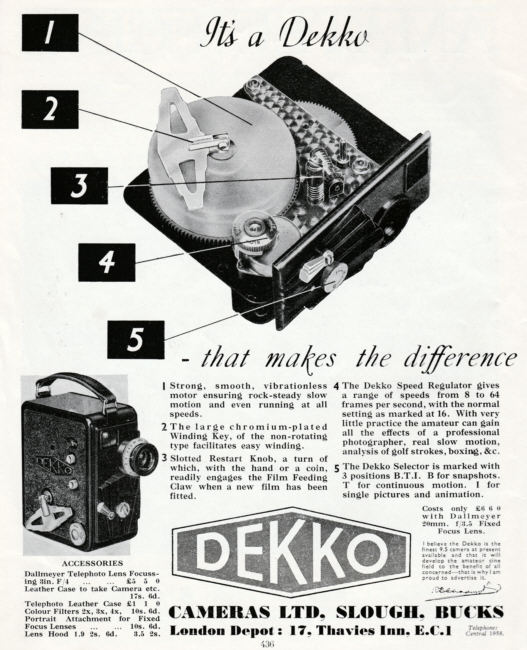
Dekko advert in the Amateur Cine World
magazine January 1935 - shows the 'innards'
DEKKO MODEL 104 9.5MM CINE CAMERA. (1937 - 1952) - Typical serial number C/319 - Also marketed as 'THE DE-LUXE'

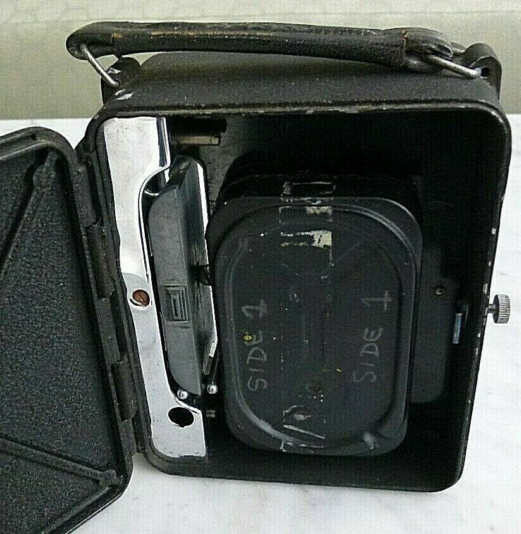
The Dekko model 104 9.5mm metal bodied cine camera -
camera door open to show 'H' film charger
By 1938, the advertiements for the Dekko 9.5mm cine camera included a model number 104, and from the illustrations, it was obvious the camera now sported a metal body. I guess the new metal body was stronger, (the bakelite of the original camera was prone to damage if heavy handled). Sadly, it meant the most of the lovely art-deco styling was lost. One can see that the mechanism remained basically the same, with similar specifications as the previous bakelite model. One difference was that the front selector dial has just two positions - 'C' and 'S' - cine / still; the start button slides to operate and can be rotated for 'lock-on run'.
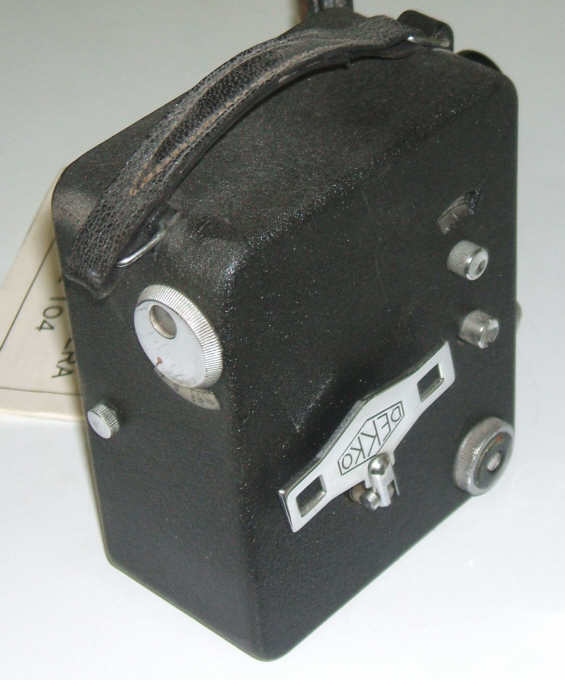
9.5mm Dekko 104 cine camera rear - the viewfinder
bezel rotates for parallex correction
Another was the provision of parallex correction on the viewfinder. The 'C' type lens mount, was again offered with various Dallymeyer or Ross lenses - the basic ones being the 23mm f2.5 fixed focus or 25mm f1.9 focussing. I had always favoured Dallmeyer lenses (my Dad's favourite!), but results from the Ross f1.9 lens were also excellent.
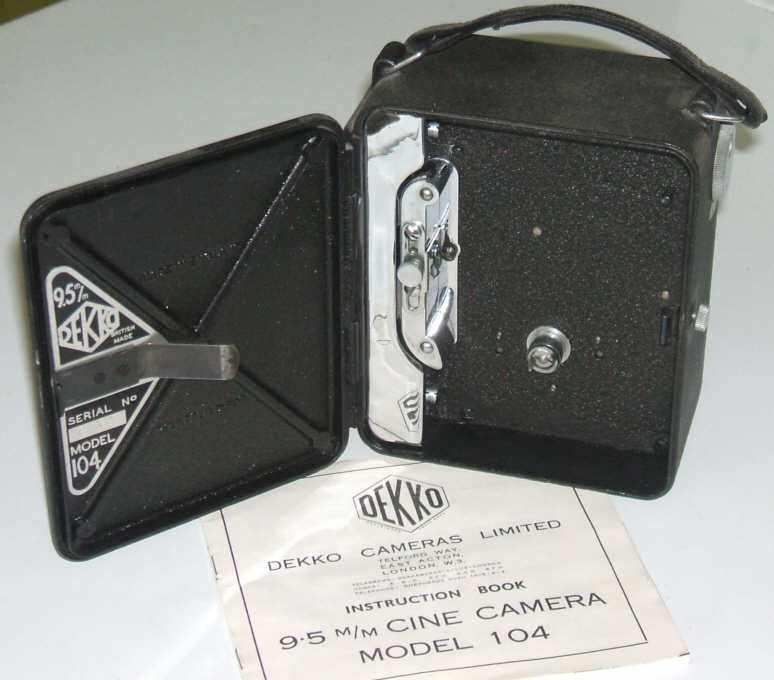
My current Dekko 104 9.5mm cine camera - door open -
chrome rsar gate on this example
DEKKO 9.5MM MODEL 3 CINE PROJECTOR (1935 - )
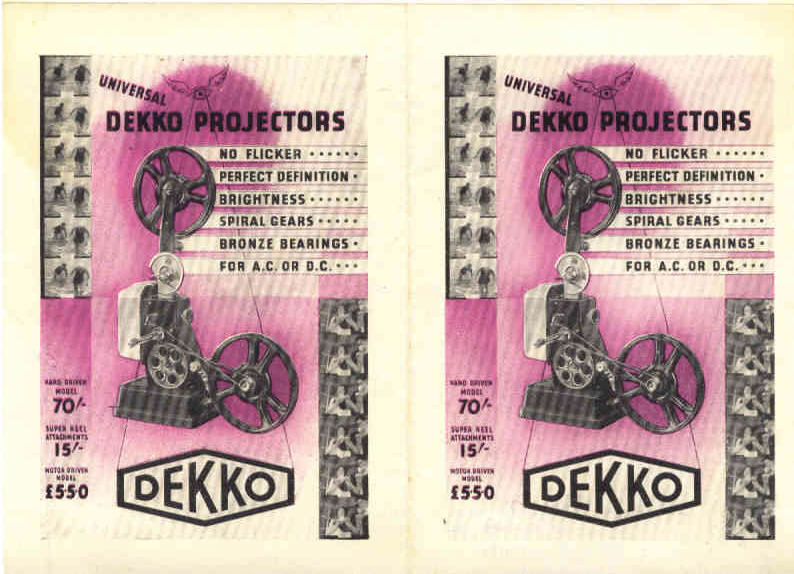
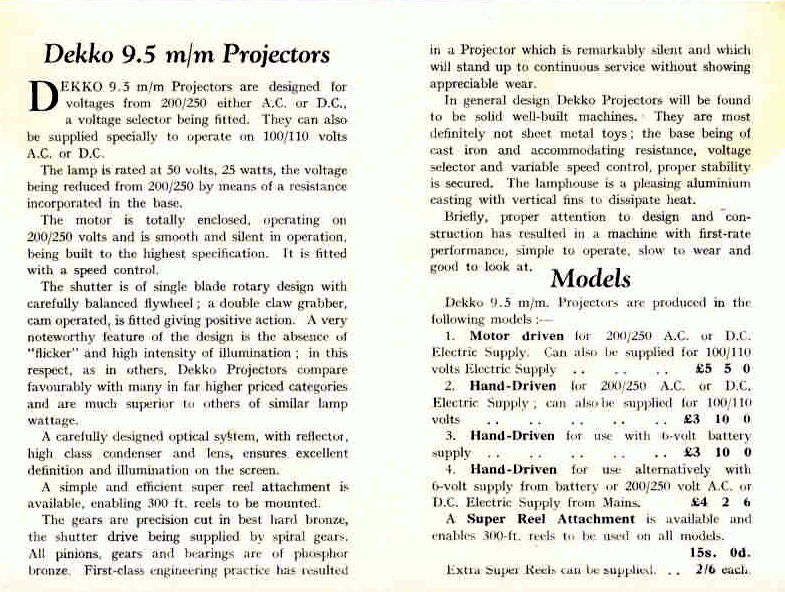
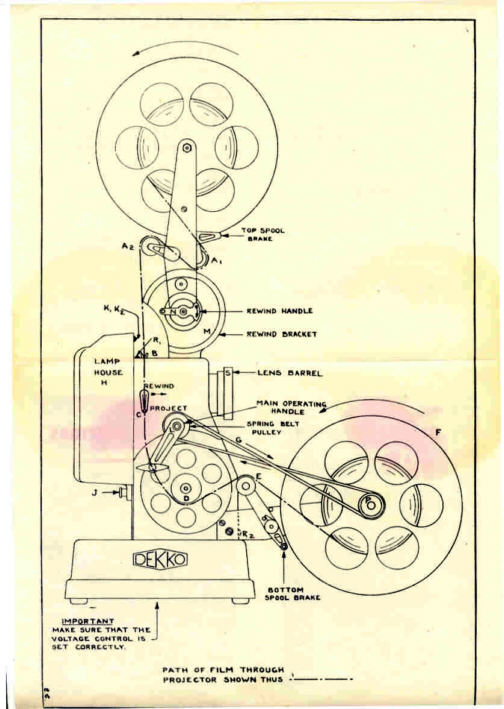
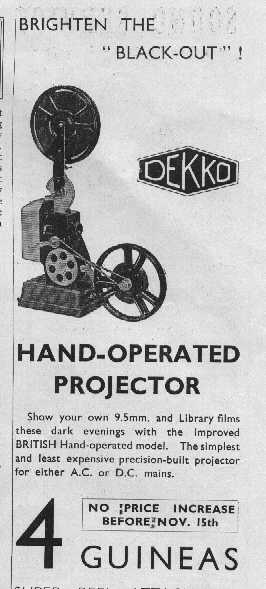
9.5mm Dekko cine projector leaflet - later 1930s
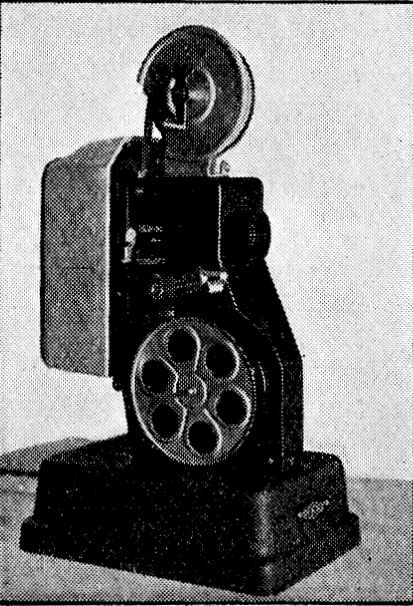
Basic Dekko hand-turned projector - only 'closed'
spools
Dekko model 3 9.5mm cine projector
Obviously marketed up and into the war!
It seems this first cine projector from Dekko was very similar to the simple Coronet 9.5mm cine projector - but the Dekko was mounted on a solid type base housing the lamp dropper resistance. The basic model just accepted the 30foot / 9metre and 60foot / 15metre 'closed' spools, However a 'super attachment' was soon available, which allowed the use of 300 foot / 100metre spools. within a year it was also marketed already fitted with an electric drive motor which could also be purchased separately. From pre-war cine books, it appears the early models had a barrel shutter .
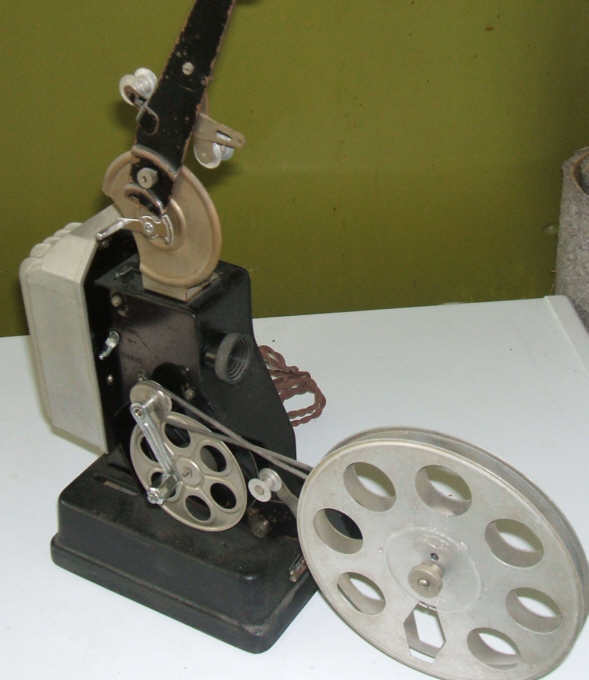
Hand-turned Dekko projector (model 3?) with
super-attachment for 300 foot /100 metre spools
Without the super attachment its overall height is 12.25 inches, and the cast iron base measures 7 x 5 inches. Separate models were supplied for high (230 volts?) and low (110 volts) ranges, and another model runs from a 6 volt battery. A fourth model provided for both 6 volt and 200-250 volt mains supply. The 'mains' models voltage adjustment was by means of a pointer situated under the base plate of the projector. The 'mains' models were fitted with a 50 volt 25 watt S.B.C. (small bayonet cap) lamp. (The lamphouse cover is removed by loosening the milled nut at the bottom and two screws at the top, then the cover is lifted up and back). The Dekko projector was not fitted with sprockets or equipped for showing 'notched' films. A clear and steady picture of 2 foot to 2 foot 6 inches width was claimed!
DEKKO 9.5MM MODEL 4 CINE PROJECTOR (1936 - 1940?)
I think the model 4 was just the motiorised version of the model 3? Or maybe this was the upgraded model wth spiral gearing and a three bladed shutter.
DEKKO 9.5MM MODEL 1939 CINE PROJECTOR (1939 - `1949?)
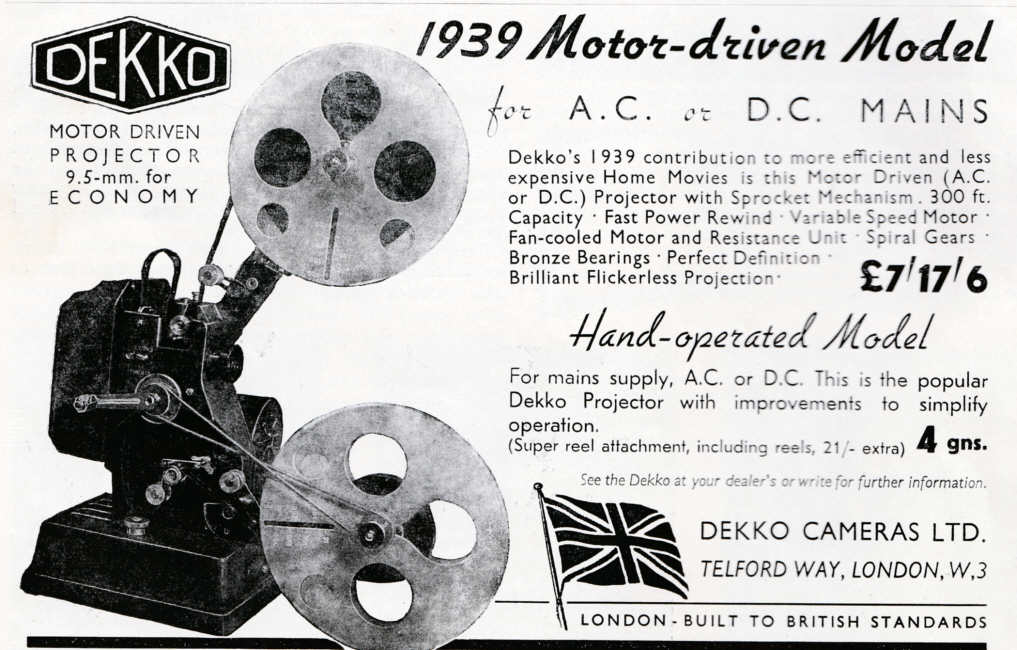
Dekko 1939 improved 9.5mm projector - Amateur Cine
World advert January 1939
Having found the necessary advertisements we can see that by 1939, Dekko had redesigned their 9.5mm cine projector to have motor drive and sprocket feed and take-up. Just reading the details above, we see that it now accepted 300/400 foot / 100/120 metre spools, had bronze bearings, and the 'flickerless projection' meant this model had a normal type shutter. I think the lighting was a 50 volt 25 watt lamp. It can be seen that this 1939 model was fitted with an unmarked bakelite lens.
The 9.5mm Dekko model 1939 cine projector was reviewed in the Amateur Cine World magazine for January 1939:-
"The base and lamp house are die-cast, the rest of the construction being heavy pressed metal. Finish is brown crackle enamel and the working face hard black enamel. The working parts are nickel plated with semi-matt finish.The lamp is 50 volt 25 watt concentrated filament pre-focus type, with domed reflector behind, and orthodox condenser system. The lens, un-named, is of simple form contained in a bakelite mount. This is a push fit in the housing on the body of the projector, focussing being accomplished by moving it backwards and forwards.
Film Transit Mechanism - Provision is made for using either super-reels or the 30ft and 60ft case type reels. For the latter a moveable fitting, which also embodies an ungeared rewind handle, is attached to the top of the projector by means of a simple stud fitting, and is instantly removeable. For super-reels, two arms, top and bottom of pressed steel, are swung into place and locked with knurled-head screws. These take super-reels, and to place these on the spindles it is first necessary to remove from each of the arms two collars. One collar is a loose pulley with a projecting stud which fits into the eccentric holes on the centres of the spools, and the other collar has a knurled edge and is a push-fit on the spindle and holds the spool in place. After these fittings are in place the spring belt drive from the main collar is placed in position.
The film from the top spool passes down over a jockey and a small pulley, then down under a feed sprocket, then a loop is made and the film is threaded down the film channel past the gate. It is not possible to see the intermittent as this channel is entirely closed, being opened slightly for threading the film by moving a small lever, and closed again for running the projector. Beneath this film channel the film passes over another sprocket, and thence to the take-up spool mechanism. The shutter is single-bladed but revolves twice for each picture. There is no noticeable flicker.
Motive Power - A small electric motor, which is mounted at the left side of the projector carcase, drives the whole instrument, including a small but powerful blower. It is controlled by a rheostat knob on the right side of the base, which operates a radial slider moving over a resistance inside the base. Another slider, which is accessible underneath the projector, moves over this resistance and enables it to be set to take supplies of 200, 230 and 250 volts. The main switch is of the push-through type, wired into the mains lead. 5 feet of lead are provided. Provision for hand-drive is provided by a crank directly fixed to the main pulley on the right side of the projector.
Rewind - The spring belt can be led up to the top spindle, or rewinding can be done by hand. It is necessary to open the gate channel by moving over a lever when this operation of rewinding is being carried out."
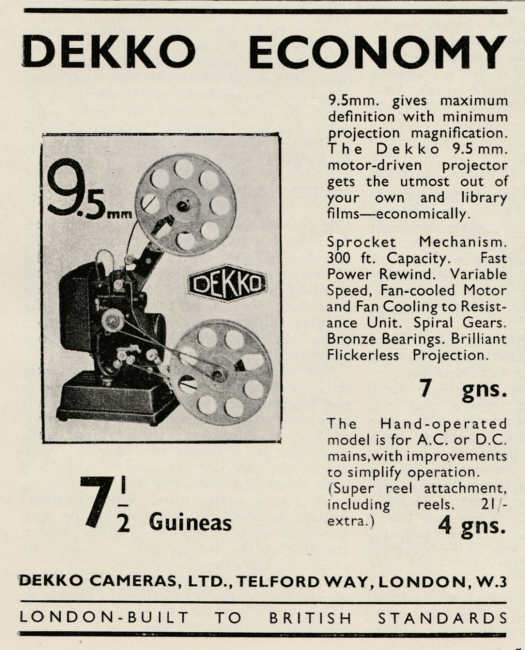
Amateur Cine World magazine advertisement February
1939
The late Gerald McKee's famous book mentions that an 8mm version was announced in 1939. I have found the advert in the Amateur Cine World magazine for Seotember 1939 - no picture though.
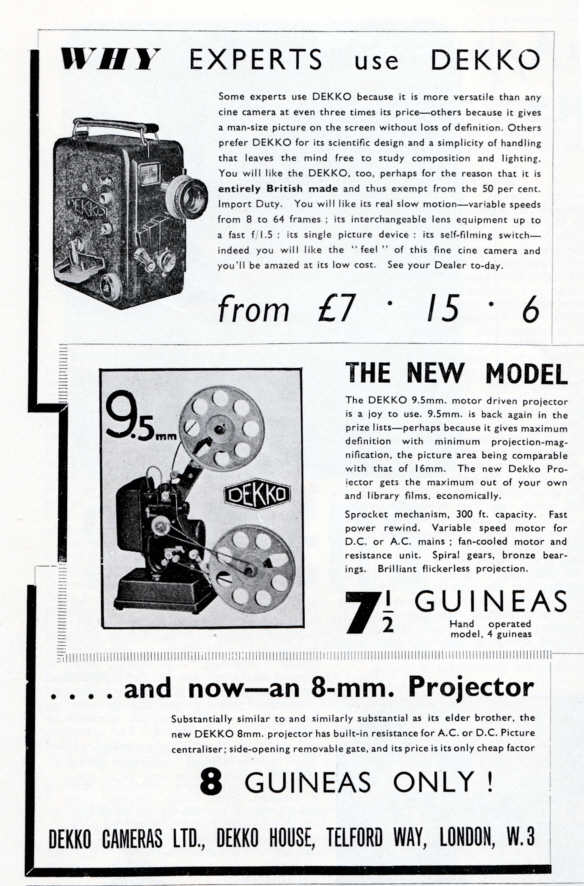
Amateur Cine World magazine Sept 1939 advertisement
DEKKO 9.5MM MODEL 48 CINE PROJECTOR (1947 - `1950?)
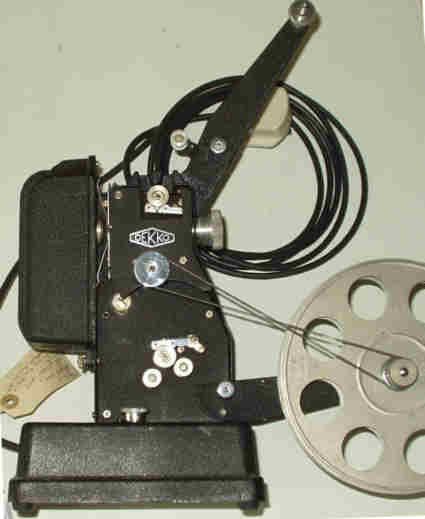
Dekko model 48 9.5mm cine projector
(note:- a 'Dekko' take-up spool)
This much improved version when launched in December 1938 was called 'Model 1939'. It was motor driven with sprocket feed and take-up. Designed for 300/400 foot / 100/120 metre spools, it also claimed bronze bearings to prevent wear. Supposedly fitted with a Dallmeyer lens, (but my example has just an unmarked metal clad lens in 19.5mm mount), it had an A1/2 type 115v volt 50 watt lamp.. My example above is in good running order, but note I have fitted a new three core mains lead and three pin earthed plug! Never play with old electrical equipment unless you know what you are doing and use an earth leakage trip adaptor!
The Dekko model 1939 projector had been upgraded a little for the Model 48 - a much brighter lamp, metal clad improved? lens?
DEKKO 9.5MM CINE SPOOLS
Dekko also produced a range of accessories for their equipment - leather cases and close-up lenses for the cine cameras and certainly 300 foot / 100 metre metal take-up spools. Silver in colour, these spools had a decent size hub with film slot and were engraved with the Dekko logo and film measurements. I have a few that actually turned up with 9.5mm films, not with the Dekko projectors!

Dekko 300/400 foot 100/120 metre take-up spool
Were there also Dekko rewinders? Let me know if you have some or have seen an advert somewhere (pre-war I guess)
DEKKO 9.5MM MODEL 119/A CINE PROJECTOR (1950 - 1955) - Typical serial number:- 9085
This new up-market Dekko cine projector was first marketed in an 8mm version in the autumn of 1949. In fact the first Dekko advertisement for this 8mm model - 118/A was in the Amateur Cine World magazine Christmas 1949 issue - just in time for that seasonal present!
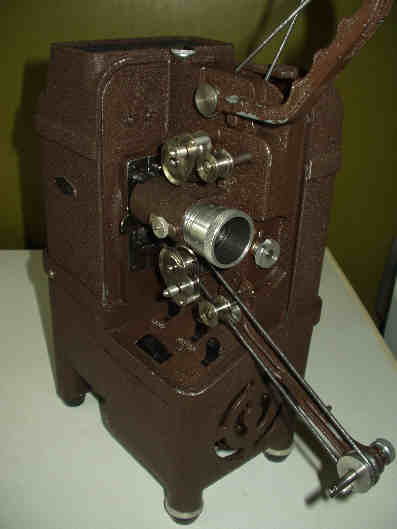
Dekko 119/A 9.5mm cine projector
Reviewed in the Amateur Cine World movie magazine in November 1950 (16mm version), this was a total rethink from Dekko for a cine projector. Fitted with sprocket feed and take--up, the sprockets had sprung side plates so that one just had to gently pull the film over the sprocket for it to be neatly clipped into place. It has a nicely finished book-form gate with the front piece removeable for cleaning. The rear part is fixed, so a gate brush comes in handy! True optical framing is provided. A three-bladed shutter gave flickerless projection at normal projection speeds. Power rewind is provided by moving the belts on the pulleys. The special reflector and condenser lens together with the Dallmeyer 'Maxlite' f1.6 38mm (2 inch / 50mm on the 16mm model) projection lens in 29.5mm diameter mount, provided a marked increase in screen illumination. (Lenses of 2.5 and 4 inch focal length were also availabele - useful for long throws in halls etc.) The machines take 400 foot /120 metre spools although the feed arm will accept an 800 foot / 250 metre spool. The review mentioned that an 800 foot take-up arm was imminent. (I have only seen machines with 400 foot take-up arms).
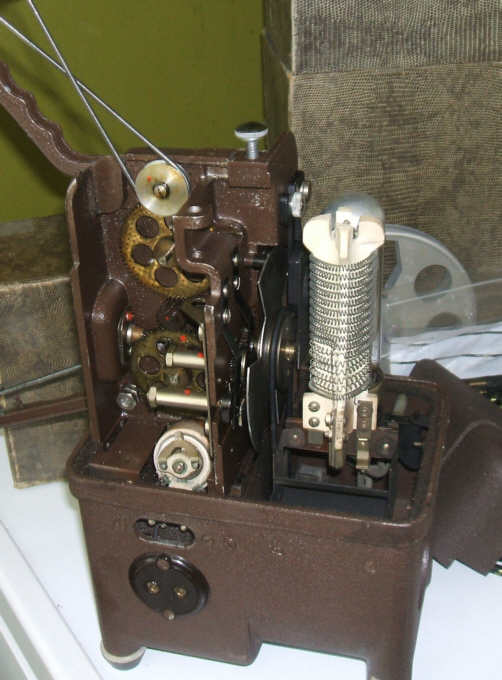
Dekko 119/A cine projector with the lamphouse cover off
This projector is made from die castings, finished in brown wrinkle with chromium plated fittings. Tilting screws are provided on the front of the base. A clever safety design means that the lamphouse cover cannot be removed unless the mains input is unplugged. The lamp and motor switches are electrically interlocked, so that the lamp can't be on unless the motor is running. An extra black bakelite switch is for a room light socket - a UK 2-pin socket on the side of the projector below the mains input socket; if you can still find a UK 2-pin mains plug!
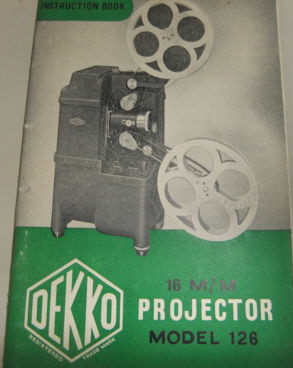
Also made in a 16mm version Model 126
This upmarket Dekko cine projector was supplied in versions for 8mm - 118/A / 9.5mm 119/A and 16mm 126/A , The suffix 'A' referred to models fitted with a 110 volt 500 watt pre-focus type lamp fed via an internal dropper resistance. These would run on 200-250 volt AC or DC mains supplies. Certainly in 16mm there was a model 126/B, which was similar but ran on any voltages from 110 to 250 by interchangeing the internal dropper resistance. Eventually there was a 126/C - this was fitted with a 110 volt 750 wattt pre-focus lamp and ran on 110 volts only. Must have provided a much brighter picture but a step-down transformer would have been needed for 200-250 volt mains supplies. No doubt the 8mm model didn't do the 500watt lamp justice, but I'm sure the 16mm model gave excellent results. I have only discovered this rather good projector in the'A' version in 9.5mm and 16mm. Sales may have been quite low. The reason? I guess the Specto 500 was more well known and a bit cheaper!
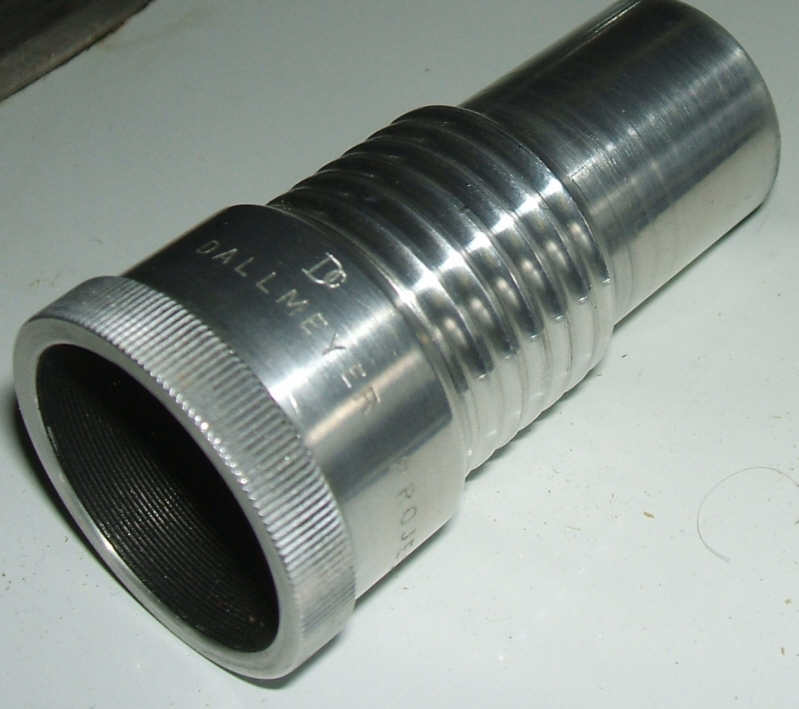
The Dallmeyer f1.9 'Maxlite' lens - 1.5 inch / 38mm focal length
on the 9.5mm model
I have just had another good 'google' and discovered a number of the std 8mm Dekko 118/A cine projectors for sale etc. - so the 8mm model was quite popular! Me, I'd go for a Eumig P8!
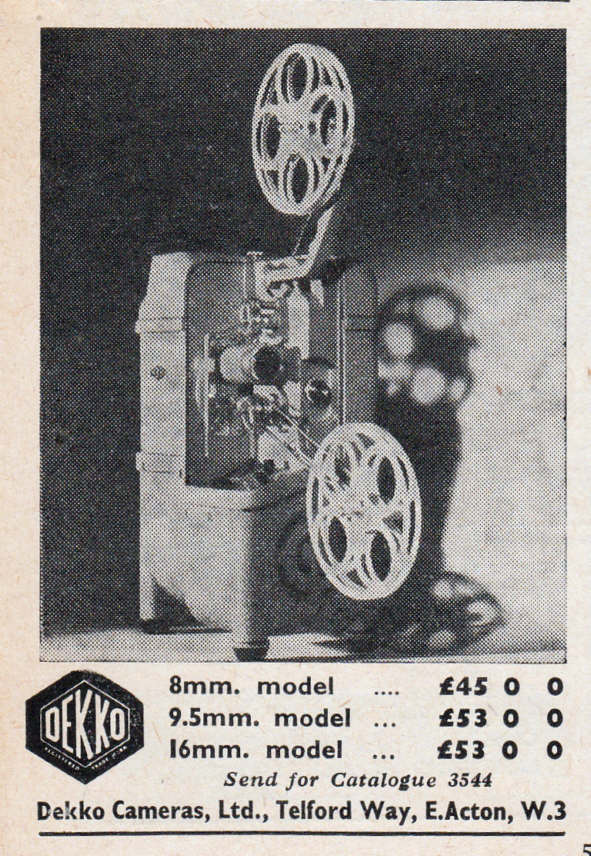
Dekko advert in the UK Amateur Cine World magazine
October 1953
DEKKO 8MM CINE CAMERAS
By the 1950s, like most other cine equipment manufacturers (except Pathéscope Ltd of course!), Dekko had moved onto other movie gauges. The main commercial target was now Kodak's 8mm film gauge. So Dekko moved onto 8mm cine cameras.
The first Dekko 8mm cine camera arrived just after World War 11, around 1947, and was the Model 110. Fitted with a National Optical f2.5 aperture 12.5mm focal length lens, it was clockwork driven, had four filming speeds and took the usual 'double-run' 25ft spools.. Typical serial number :- F/1086
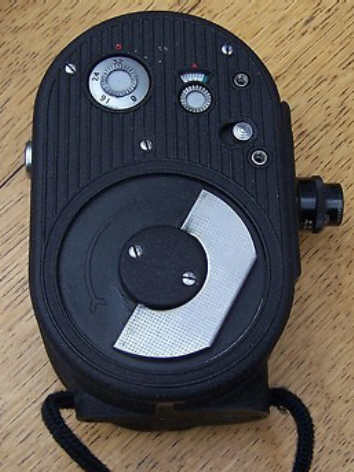
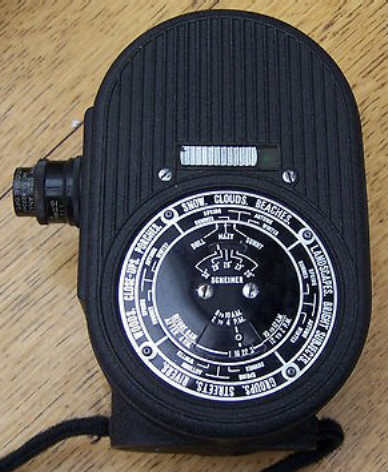
Dekko 110 8mm cine camera
The next (and probably the last) 8mm Dekko cine caamera was model 128. Still British designed and manufactured, by now many cine cameras were flooding into the UK from overseas - and these others were often heavily marketed, looked more modern and were cheaper!
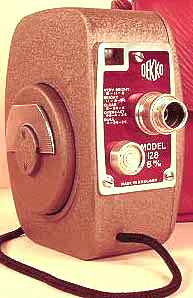
Dekko 8mm 128 cine camera
I think their last effort was the Dekko model 128 8mm cine camera. Quite neat and attractive, but rather similar to other more heavily marketed products. Produced in 1951, the 128 was standard 8mm 'double run' taking 25foot / 9metre spools. It was normally supplied with a National Optical f2.5 aperture 12.5mm focal length interchangeable lens in the standard 'D' mount. Weight just under a Kilogram, size 63 x 127 x 127 mm. Sadly it didn't sell too well and was probably the swansong for Dekko domestic movie equipment.
However, sincev the war, Dekko had been moving into industrial high-speed cine cameras, and other electronic fields. They continued with these products well into the 1960s.
DEKKO MILITARY CAMERAS
During the second waorld war, Dekko produced specialised cine camera products for miltary aircraft use. Later they developed cine cameras to film missile launches etc. The first was a Model N I think. The later model GW1 had a Beck lens, and was a high-speed cine camera, used for monitoring misssile launches
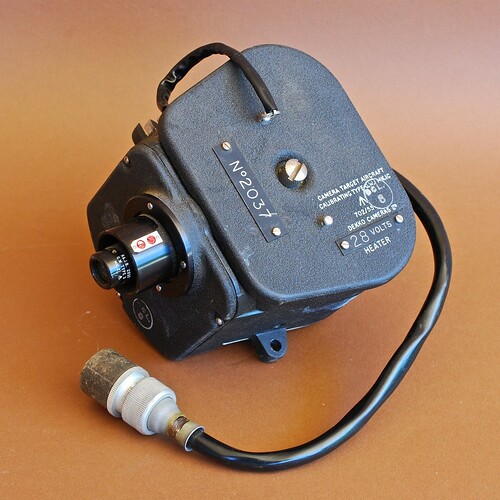
.Dekko military GW1 cine camera (photo courtesy Dirk
HR Spenneman)
I am always most grateful for any extra details or information!.
©Grahame L. Newnham - 29May2019.
REFERENCES
"The Complete 9.5mm
Cinematographer" - Harold B. Abbott -
1936? Illiffe & Sons Ltd.
"The Home Cinema -Classic Home Movie
Projectors 1922-1940" - Gerald McKee
1989 ISBN 0-9515905-0-2
"Amateur Cine World"
movie magazine - November 1950
Return to: 9.5 EQUIPMENT PAGE ............ or NINEFIVE MENU ............ or return to MAIN MENU
Created 29May2019 ........... Last updated: 09 February 2020 ..............
95geardekko.htm ............ @Grahame L. Newnham's web pages
03June2019 - lens and spool photos added / 09Jun2019 - camera
& projector photos added
10Jun2019 - Dekko camera & projector leaflet scans added /
15jun2019 - more Dekko adverts added / 21Jun2019 - another Dekko
advert
04Oct2019 - Typos & Dekko 118/119/126 projectors Oct1953 ACW
advert added