 |
CINÉRIC | CINÉRIC |
Grahame N's Web Pages
9.5MM
CINÉRIC
CINE PROJECTORS
by Grahame L. Newnham
|
CINÉRIC | CINÉRIC |
THE BEGINNINGS OF CINERIC CINE PROJECTORS - late 1940s
I know very little about the Cinéric 9.5mm cine projectors that sometimes turn up at French cine fairs and on French ebay. Somewhere I recall a little article about the origins of the company, if I find it again I can update this piece.
 1930s Ericsson 16mm talkie
projector
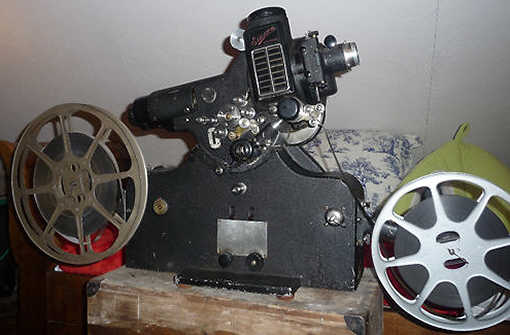 An actual photo!
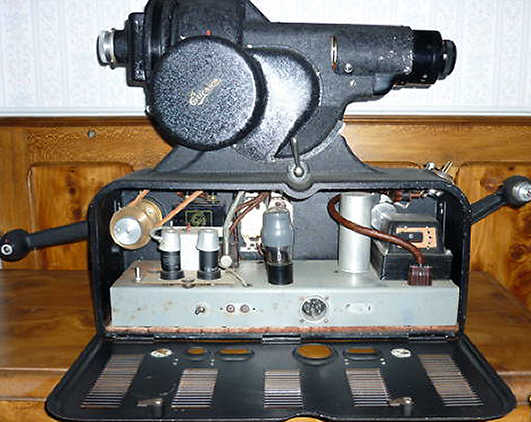 The innards!
It appears a French company, Société des Telephones Ericsson produced some cine projectors during the 1930s. Sometime in the late 1940s after the second World War, the Cinéric company was formed in Paris. An S.A.R.L. with capital of 32,000,000 Francs. Maybe set-up as a subsiduary of Ericsson? The first advertisements I have found so far, appeared in 1950, when the company had a stand at the Paris Photo Fair.
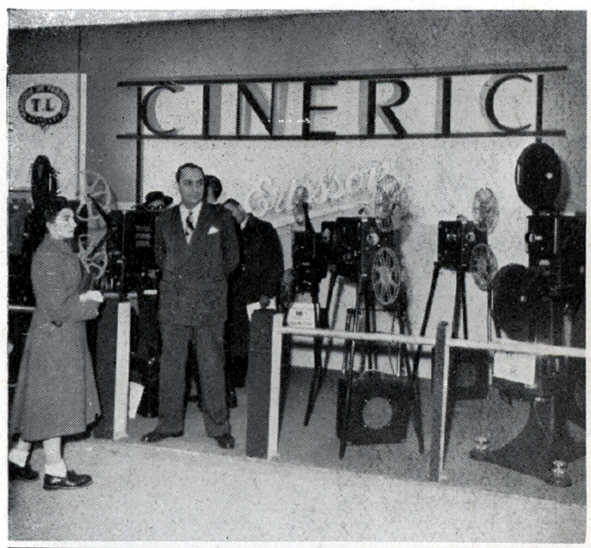
Cinéric stand at the 1950 Paris Photo Fair
THE CINÉRIC 16MM SC CINE PROJECTOR - 1940s

Ericsson - Cineric 16mm SC 16mm sound projector
I had wondered about the models 'A'; 'B' and 'C' - well I believe this is a model 'SC'! An early 16mm talkie projector, sometimes just pictured as the basic projector without the stand or the spool boxes. Pehaps this model is actually a 35mm model, hence the spool boxes. More information gladly received - they certainly didn't produce a 9.5mm version!
THE CINÉRIC 8MM LOR & 16MM SD / MD CINE PROJECTORS - 1950

Advert in French Ciné Amateur magazine March 1950
Launched at the Paris Photo Fair were two cine projectors from Cinéric. A rather weird looking std 8mm cine projector named 'Lor' and a decent 16mm cine projector available in silent and talkie versions named 'SD'. The name Ericsson was still retained in the projector name, but the registered company was now just Cinéric.
The 8mm motor driven 'Lor' featured side by side feed and take-up spool arrangement. It accepted up to 400 foot / 120 metre spools, had power rewind, and a 200 watt lamp. It was fitted with an f1.5 20mm lens. Maybe it was just distributed by Cinéric or did they actually manufacture this machine; it certainly soon dissapeared from their advertisements within a year.
The 16mm Cinéric projector model 'M.D.' was silent (muet in French, hence the 'M'?) and took up to 1000 foot / 300 metre spools, 16 or 24 frames/second motor driven with power rewind, a pilot light, a 50mm lens and 500 watt lamp.
The 16mm talkie version model 'S.D.' (sound is sonore in French, hence the 'S'?), took up to 2000 foot / 600 metre spools, 16 or 24 frames/second motor driven with power rewind, a pilot light, a 50mm lens and 750 watt lamp. The amplifier gave up to 12 watts output.
The 16mm cine projectors were built into a sturdy wooden case with folding/detachable spool arms at the front. Regular advertising continued in the French cine magazines, but dealers didn't yet seem to include the nane Cinéric in their cine projector sales lists.
(All the technical information comes from
a table of current cine projectors in the French Ciné Amateur
magazine dated July 1950. Sorry but no mention of 9.5mm yet but
give it time!)
THE CINÉRIC MODEL 'E' CINE PROJECTOR - 1951
It seems logical that Cineric were working theit way through the alphabet for their projector models (see the 16mm model D above), but I wonder what happened to the 'A'; 'B' and 'C' versions?

Advert in French Ciné Amateur magazine March 1952
This new design Cinéric cine projector seems to have been launched at the 1952 Paris Photo Fair. (The upmarket 16mm talkie machine was still in production).
Marketed as 'Model E' this silent machine was available in 8mm ; 9.5mm and 16mm versions. Housed in a brown bakelite case with the actual mechanism mounted on a metal cream/yellow finished chassis, this and later design machines do look rather attractive! The folding spool arms mounted on the top of the machine, accept up to 400 foot / 120 metre spools. There is a strong, folding carry handle also mounted on the top of the machine. It is driven by a powerful, variable speed series wound motor. Mains voltage lamps with standard pre-focus base are fitted. In this model maybe up to 300 watts. The lens barrel is the standard 'Euro-mount' of 32.5mm and normally a suitable Som Berthiot lens was fitted - 20mm for 8mm; 35mm for 9.5mm and 50mm for 16mm. A pilot lamp (MES base) is extinguished when the lamp is switched on. Although the side door is opened for threading and focussing, I guess the machine can be run with the door closed for quieter running.

Cineric model 'E' - an 8mm version, missing the lens
too - photo from French ebay
Whilst the brown bakelite body looks rather attractive, I doubt if it is really durable enough for rough handling, maybe the reason for later models to be modified. (Or were they?)
THE CINÉRIC MODEL 'F' CINE PROJECTOR - 1955?
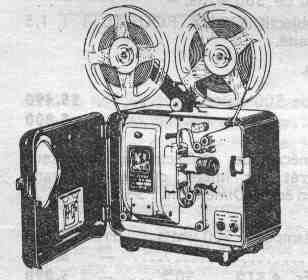
Much the same as the model 'E' detailed above, the model 'F' seems to have had a few improvements. It had a room lamp socket on the front of the machine, switching off as the projector lamp is switched on. I imagine it had 'lamp pre-heat' like the special Tiranty model detailed below. No doubt this model was also suitable for both 110 and 220 volt mains supplies. Certainly it acccepted pre-focus base, mains voltage lamps up to 500 watts (A1/7). Also available in 9.5mm and 16mm with extendable spool arms for 1000 foot / 300 metre spools.
Available in 9.5mm & 16mm
with 1000 foot / 300 metre spool arms
Just found this photo on
the internet showing a machine with extendable spool arms - handy
for longer running film shows.
THE CINÉRIC MODEL 'T' (TIRANTY) 9.5mm CINE PROJECTOR - 1955?

Not sure which way up this
advert actually appeared!
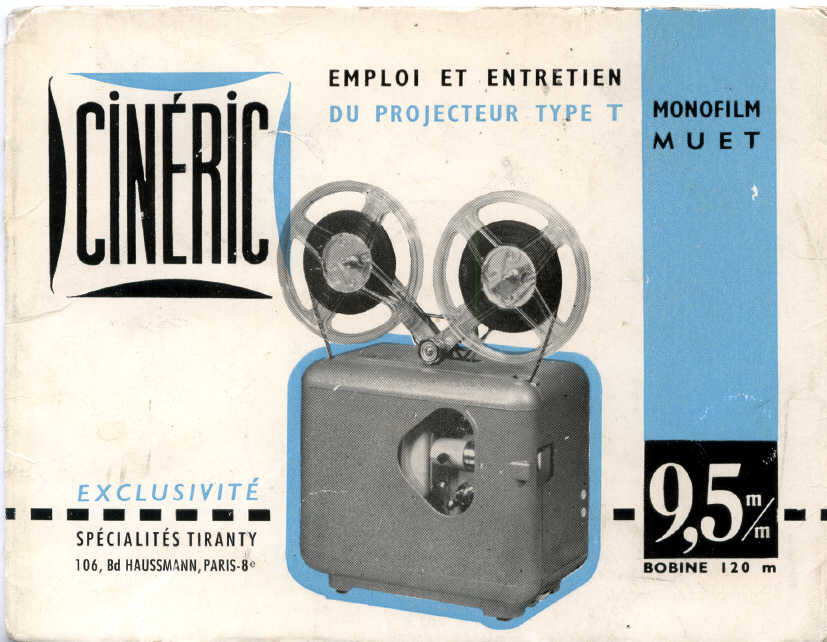
Instruction booklet front page
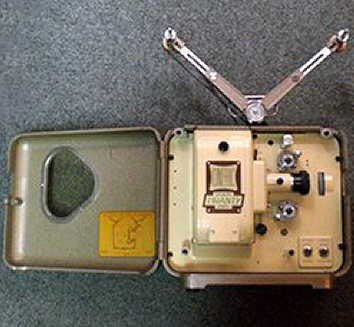
A model not in the Cinéric advertisements and not in the progressive alphabetical list! Now Tiranty were a long standing retail photographic business in Paris - I guess they commisioned this model as an exclusive product for themselves - maybe just the 9.5mm version - perhaps to keep a 9.5mm version available. I have a lovely example with the instruction booklet. It is really just a model 'F'. Now the French AC mains supply was 110 volts up to around 1955. My example has just 110 volt input, but the instruction booklet also mentions a dual 110 / 220 volt version. So I guess these must date from around 1955.
The machine is almost idenical to a model 'F', but I don't have one to compare. Unlike the bakelite series 'E', these models had an identical casing, but in a mottled light brown finished light metal casting (or is this still bakelite?). The operating side door has a plastic inspection/vewing window, maybe this could be closed for projection, but focussing requires the door open. Certainly the machine runs quietely even with the door open.
The projector has folding 400 foot / 120 metre spool arms on the top of the case; also a sturdy fold-down carry handle. The powerful variable speed series wound motor drives the mechanism via a rubber belt. (The speed control is on the rear of the projector). The lens mount of 32.5mm diameter has a f1.6 35mm Benoist Berthiot Cinestar lens giving a really bright pin-sharp picture. There is power rewind, achieved by changing clutches on the feed and rewind arms. There is an adjustable height control at the front of the machine. A room light socket on the front of the machine goes off with the lamp switch. The pre-focus base mains voltage lamps (up to 500 watt) goes to pre-heat when the motor is started and is switched to full power by the lamp switch. A pilot lamp (E10 / MES base) mounted above the top sprocket goes off when the projection lamp comes on.
My example performs very well, running quietly and giving a very bright steady and sharp picture. An odd criticism is that the spool retainers are a bit unorthodox and are prone to let the spools fall off or even rufuse to accept the UK Pathéscope aluminium 200 foot spools for example. Judicial use of a needle file seems to have solved part of the problem, but I notice that the previous French owner who used the machine for film to digital transfers, had employed little rubber grommets to slip over the spindle ends to retain the spools securely. (He kept them on the switch spindles!)
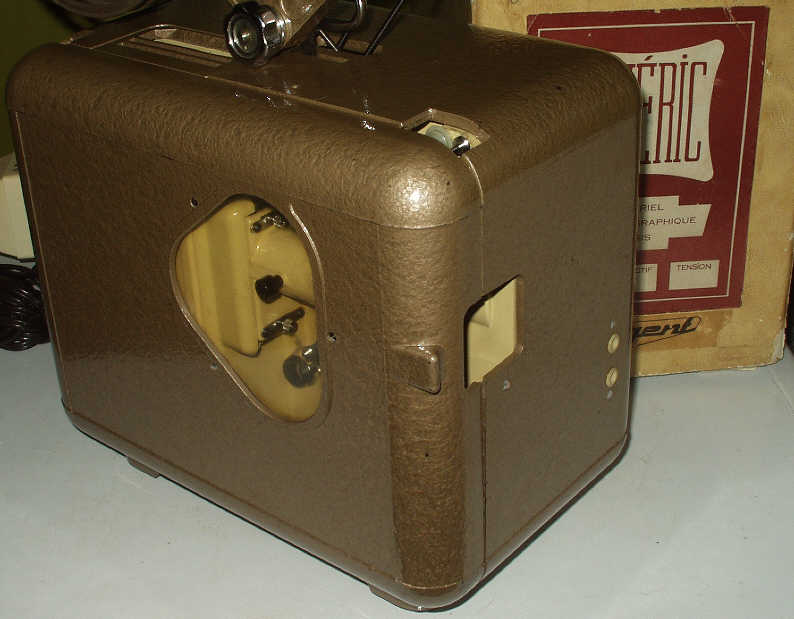
Cineric model 'T' 9.5mm projector

Cineric model 'T' 9.5mm projector - side door open

Cineric model 'T' 9.5mm projector - switches and lower sprocket
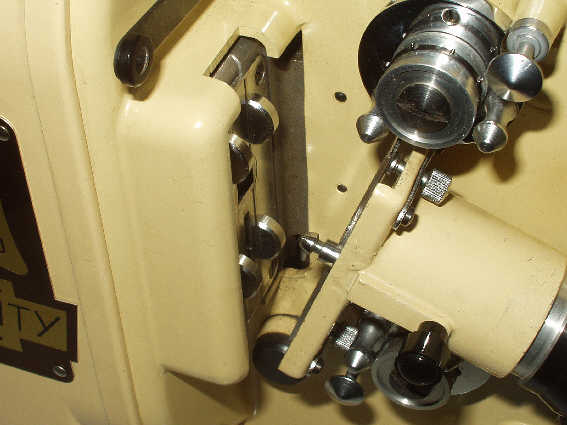
Cineric model 'T' 9.5mm projector - film gate open
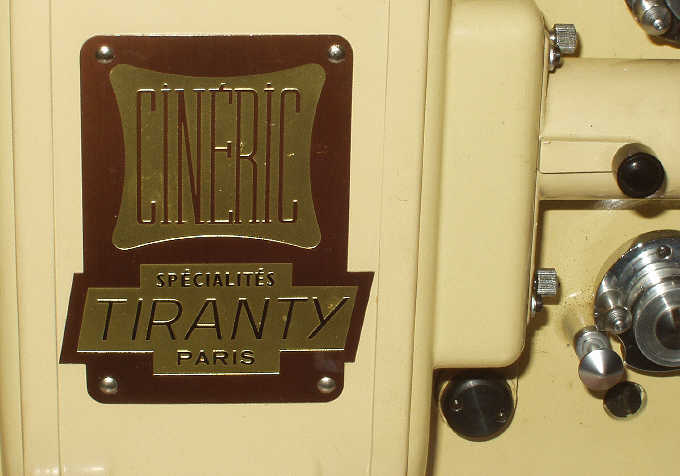
Cineric model 'T' 9.5mm projector - Tiranty special name plate
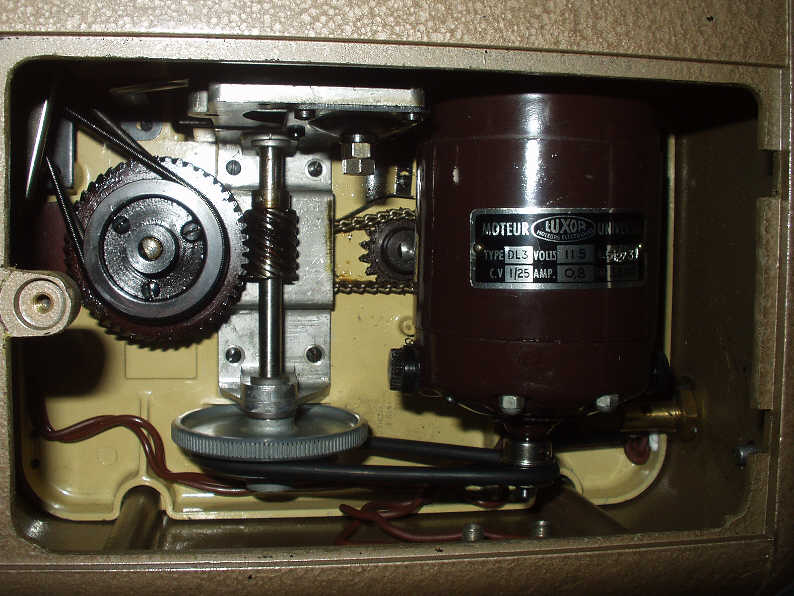
Cineric model 'T' 9.5mm projector - rear inspection cover removed
to show motor and drive belt
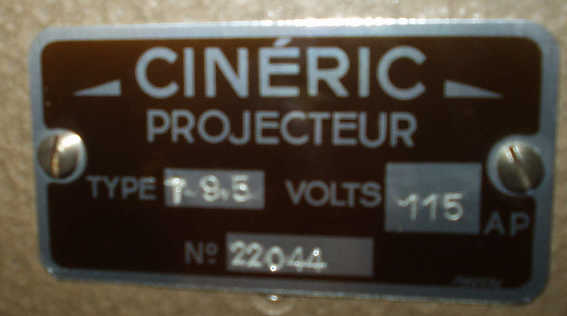
Cineric model 'T' 9.5mm projector - spec. plate on bottom of
machine
Whilst I curently have a good supply of pre-focus base lamps, there is probably ample room inside the body to fit a toroid type transformer to supply the 110 volts for the motor and say 24 volts for a 150 or 250 wat QI comnversion.
Again there is possibly room for an optical sound version, but I can find no record of such a model.
(I do stock new motor drive belts and the little MES pilot lamps, but those pre-focus lamps are quite rare these days!)
THE FINAL CINÉRIC CINE PROJECTOR MODELS? - 1957
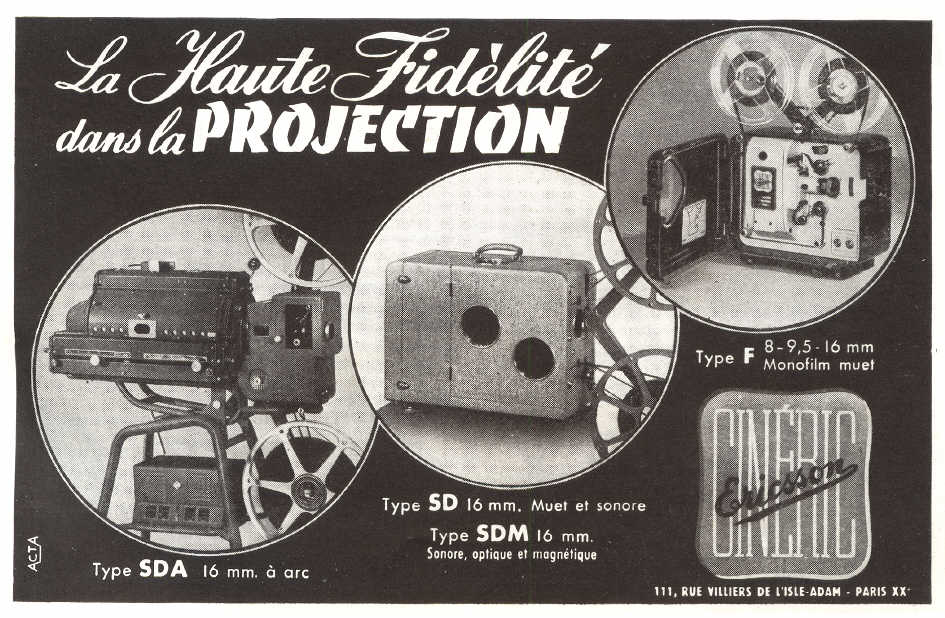
Advertisement in the French Pathé 'Le Cinema Chez
Soi' magazine - February 1957
So we know that from the advert above that in 1957, the 16mm 'SD' optical sound and 'MD' silent machines were still available, plus the 'SDM' also with magnetic sound. The model 'F' continues in 8mm, 9.5mm and 16m silent; and now also a fancy 16mm arc projector, the 'SDA'.
CINÉRIC - 1960

Cinéric leaflet 1960
For 1960 Cineric introduced an 8mm (yes std 8mm in those days!) cine camera called the 'Princesse'. Presumably with the std 8mm 'D' lens mount, it was supplied with a Berthiot 'Servo-Cinor' lens which gave auto exposure. Looking at the leaflet above, it could also have a zoom lens fitted. I have never seen an example of this camera, but then I rweally only collect 9.5mm gear! No doubt one could be spotted on French ebay.
The standard Cineric cine projector has
by now 'morfed' into a model 'Regent'. Looking much the same as
earlier models, this 8mm version claimed higher light output from
a low voltage 10 volt 100 watt (Saipe) lamp. This French designed
Saipe lamp, like other low voltage lamps is used in some 9.5mm
Cinegel projectors and is now difficult to source.
THE DEMISE OF CINÉRIC - 1961
It was around 1961 that the remains of Pathé, Erscam and Cinéric merged to become E.P.C. (Erscam/Pathé/Cinéric) based in the old Erscam premises at 221 Rue Lafayette, Paris X. Sadly because of higher quality and lower price photographic products fron Japan, the European photographic industry was now in free fall.
Return to: 9.5 EQUIPMENT PAGE ............ or NINEFIVE MENU ............ or return to MAIN MENU
Created 12Nov2017 ............ Last updated: 13 October 2019 ..................... 95gearcineric.htm .................. © Grahame L. Newnham's web pages MMXV11