 |
ARGUS |
|
1
Grahame N's Web Pages
9.5MM
ARGUS
CINE CAMERA
by Grahame Newnham
|
ARGUS |
|
. I know very little about the Argus 9.5mm cine camera - really just information gleaned from the 1930s advertisements in the amateur cine books and magazzines. I recall that an example did surface at a Group 9.5 Get-Together, but it wasn't in working order and I didn't get a close look. We know there is an example in the Science Museum Collection - no doubt from the late John Burgoyne Johnson collection that is rumoiured to reside in some storage facility in the Midlands somewhere!
Here is the Science Museum listing fot the Argus 9.5mm cine camera -
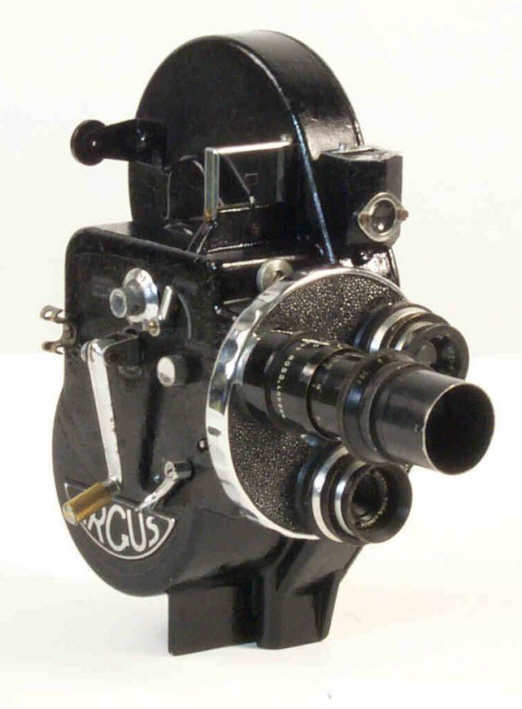
9.5mm Argus cine camera (Science Museum Photo0
Argus 9.5 camera :-. Clockwork-driven 9.5mm camera takes film on 50' or 100' spools. Runs at shooting speeds from 12 to 64 frames/second. It can also run in reverse. Driven by two sprocket drives with a claw intermittent. The three-lens turret has an f/2.9 15mm Ross Xpress lens (Serial No 132401); an f/1.9 1 inch Ross Cine lens (Serial No 134735) and an f/5.5 4" Ross Teleros lens (Serial No 132221), all with rubber caps. All C mount. There is a direct vision 'sight' finder above the turret and a reflex finder, neither calibrated for different focal length lenses. The camera also has a dial to indicate the amount of tension in the spring of the clockwork motor.
The Argus Cine Camera seems to have disappeared with the World War in 1939 and didn't reappear afterwards.
ARGUS 9.5MM CINE CAMERA - UK - approx 1935 - 1939?

Argus 9.5mm cine camera advert
Rather a rare animal this semi-professional 9.5mm cine camera. Maybe because they were quite expensive, and possibly because it was one of the first spool loading cameras. The film was probably difficult to source in the mid. 1930s - most 9.5mm cine cameras were charger loading. These days the only example I have come across was badly deteriorating, in fact falling apart - can't remember, but whatever hed it togetherc was failing - perhaps some 'mazak' used in the body.
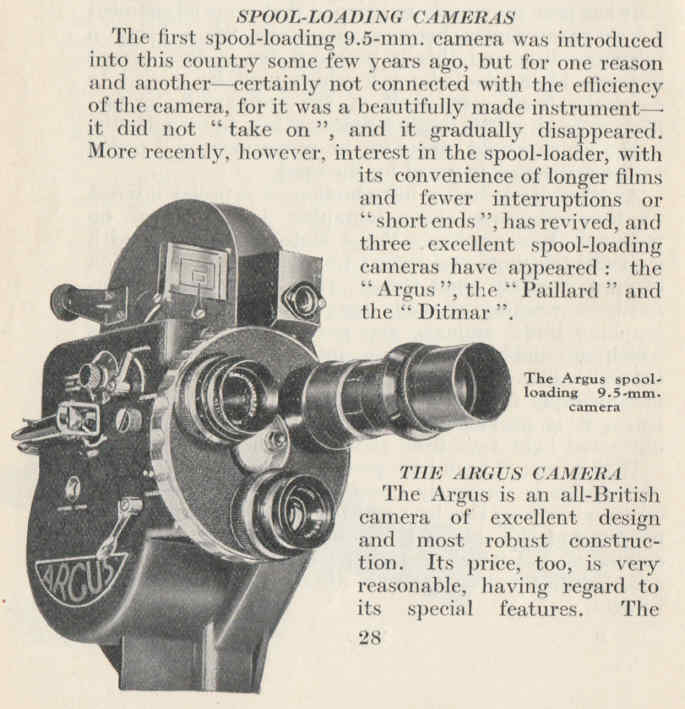
From the Harold Abbott book 'The Complete 9.5mm
Cinematographer'
The Argus is an all-British camera of excellent design and robust construction. Its price, too, is very reasonable, having regard to its special features. The body is of die-cast metal throughout, finished in crackle enamel, and is almost incapable of being damaged. A revolving turret enables any one of three lenses to be instantly brought into position for use, the view-finder being marked for a 15mm (wide-angle) lens, a 1 inch (normal) and a 4 inch (telephoto) lens.
In addition to the direct vision view-finder a brilliant reflecting (or "waist-level") view-finder is permanently attached to the camera body and is marked for 15mm and 1 inch lenses.
Camera speeds from 12 to 64 frames per second are provided, the regulator being marked for 12, 16, 32 and 64 f.p.s. ; but intermediate speeds may be used if desired, in which case they must be estimated. A selector allows the camera to be set for "brief time" (normal camera work), "time" (self-running), and single pictures, the latter being "instantaneously" exposed according to the speed at which the "f.p.s." regulator is set. As with most 9.5mm cameras, single pictures cannot be given "time" exposures.
A most useful feature of the Argus is the reverse movement which allows the film to travel in the reverse direction in the camera. Not only is this useful for trick photography but it also facilitates the making of "dissolves" and double exposures, about which information is given in Chapter 11.
The film indicator measures in feet the amount of film consumed and, being situated immediately below the front element of the direct-vision view-finder, can be kept under observation all the time that filming is actually in progress. When the mechanism is reversed the film indicator moves backward; therefore the operator is able to "run back" the exact amount of film desired.
A most important point, and one that is not sufficiently stressed in the instructions, is that when moving the reversing lever either to "forward" or "reverse", the tension of the motor spring must be held by placing the winding handle in position and pressing slightly as though you are about to wind the camera. Unless this is done the spring will discharge itself at one leap, with probably serious consequences to the motor. This precaution is only necessary during the actual movement of the reversing lever; once it has been set no further attention is necessary.
The motor spring is wound by a folding handle, and a "spring load indicator" is provided which shows "0" when the spring is discharged, and "10" when it is fully wound. Intermediate markings of 2, 4, 6 and 8 furnish a most valuable indication of the state of the spring and ensure the operator shall not start filming with insufficient winding to "see the shot out".
A full wind exposes about 18 feet of film, and the motor automatically stops itself when the spring load indicator shows "0". At this point the spring is not entirely discharged but has suffient power to maintain constant speed and exposure, and the fact of it automatically "cutting out" at this stage is a most valuable feature, preventing, as it does, the waste of film which would otherwise be spoiled as the mechanism slowed down
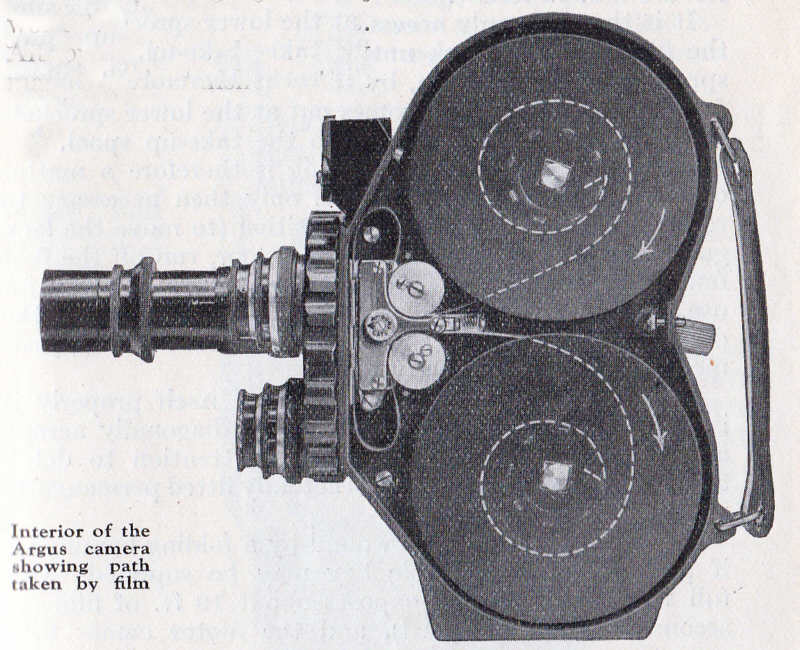
The lid, or door, of the Argus is entirely removeable, and the illustration on page 31 (see below) shows the interior of the camera. The spool of unexposed film is placed in the top section of the camera, the empty receiving spool reposing in the lower section.
The path of the film is clearly shown in the illustration and it will be observed that the supply and take-up are regulated by two sprocket wheels (teeth not visible in the illustration), so that the claw does not have to drag the film from the supply spool but merely operates on the small section of the film shown looped above and below the gate.
By giving a quarter-turn clockwise to the small knob seen in the centre of the gate unit, the latter draws away from the sprockets and the flm channel, leaving a clear passage into which the film may be introduced sideways. When the film has been properly threaded the gate knob is given a quarter-turn anti-clockwise and the film is then pressed in contact with the sprockets and film channel.
It is a feature of the Argus that the whole of the gate unit and the sprocket wheels may be lifted out, leaving the film channel entirely free for cleaning purposes and also for visual focussing - a subject that is deealt with in the chapter on title-making.
Film for the Argus (and of course for the Paillard and Ditmar) is obtainable in 50 foot and 100 foot lengths, mounted on a special daylight-loading spool, as already mentioned on page 4.
A fine, sweet-running camera, the Argus meets every reasonable requirement of the amateur cine-photographer, and if obtained with its battery of three lenses it will cope with practically every situation.
(for simplicity,I have copied the complete camera write-ups from the Harold Abbott book "The Complete 9.5mm Cinematographer" which dates from about 1937 the middle 1930s)
REFERENCES
"The Complete 9.5mm Cinematographer" - Harold B. Abbott - 1936? Illiffe & Sons Ltd.
Return to: 9.5 EQUIPMENT PAGE ............ or NINEFIVE MENU ............ or return to MAIN MENU
Created 09Jun2019 ............ Last updated: 11 June 2019 ..................... 95gearargus.htm .................. © Grahame L. Newnham's web pages MMX1X