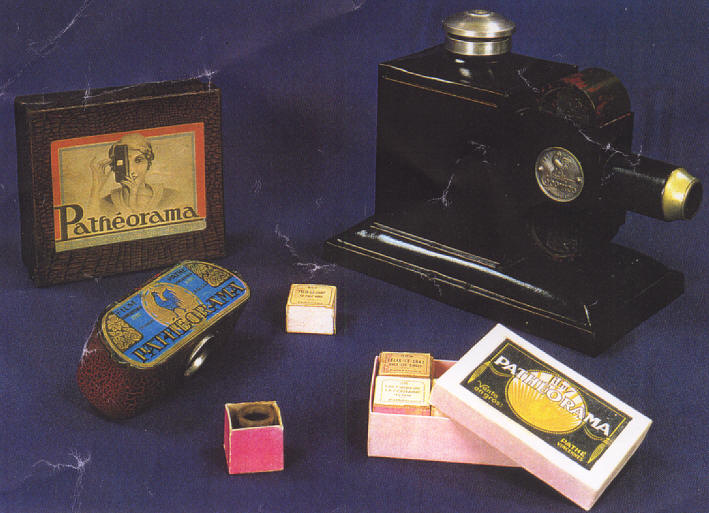
French made Pathé "Pathéorama" hand held viewer, boxed filmstrips and "Cocorico" projector from around 1923
THE
PATHÉORAMA
VIEWER AND
COCORICO PROJECTOR
French made Pathé "Pathéorama" hand held viewer,
boxed filmstrips and "Cocorico" projector from around
1923

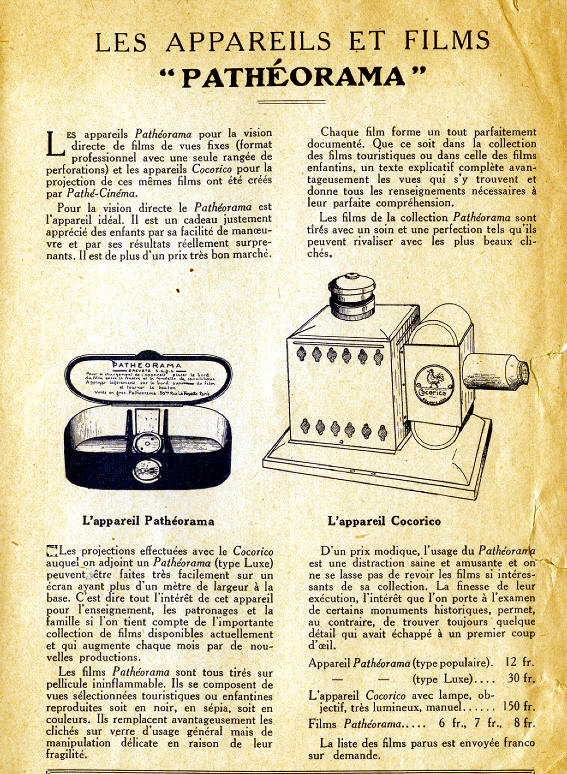
1924 French advert for the Patheorama viewer and Cocorico
projector
Even by 1912 or so, the French based Pathé-Frérès entertainment group had already become a leading light not only in the recorded music business, but also in the cinema business - supposedly by this time they accounted for about half the world wide sales of 35mm movie equiopment. They also had a huge back catalogue of entertainment films, and had perfected ingenious was of colouring film releases either by chemical staining or tinting and by their very clever stencil colour process. Obviously some bright spark at Pathé headquarters at Vincennes spotted a way of using some of their back catalogue material and keeping those processing, toning and stencil colouring departments at work.
The gimmick was a little hand held filmstrip viewer - early ones were made from a sort of cheap hard type material (known in French as bouilli - meaning boiled leather?, but perhaps boiled cardboard), later versions were in brown bakelite and black pressed tinplate. The product name was immediately coined (and patented!) as Pathéorama. It is diffficult to date the first products, certainly by the early 1920s there were adverts in the French popular press and magazines. I think one of my examples has a patent date of 1922. The devices used a length of 35mm cinema film (they did use safety non-flam filmstock), with images and titles. However the film had one set of perforations cut off, again enabling it to be patented ensuring the 'exclusivity' that seemed to follow most Pathé products.
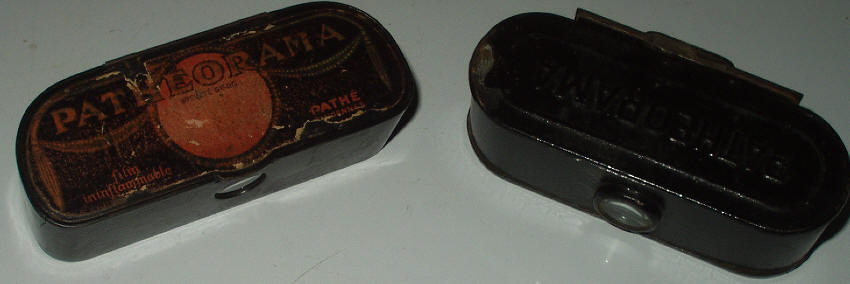
The lid of the viewer opens up to allow the filmstrip to be threaded, which is transported through the viewer using a small knob on the outside. In fact there is enough room in the inside to accomodate a couple of extra filmstrips.
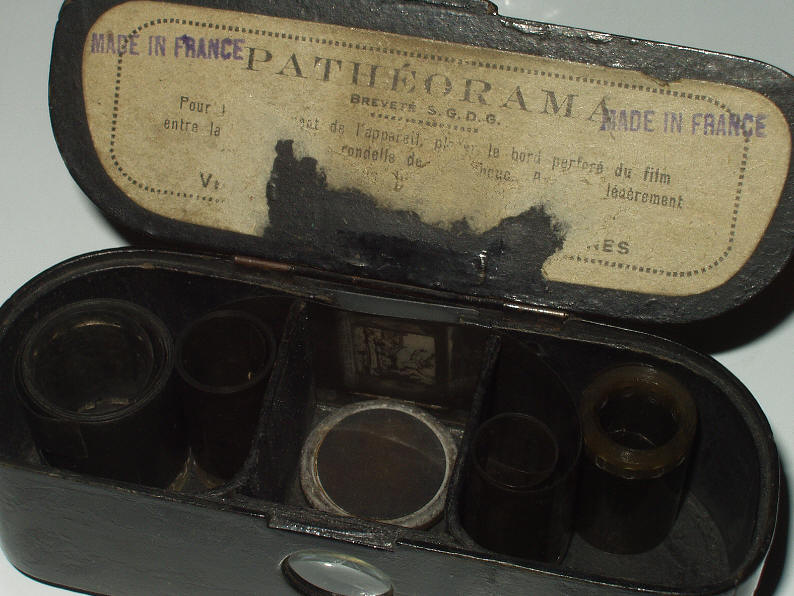
Pathéorama viewer with lid open
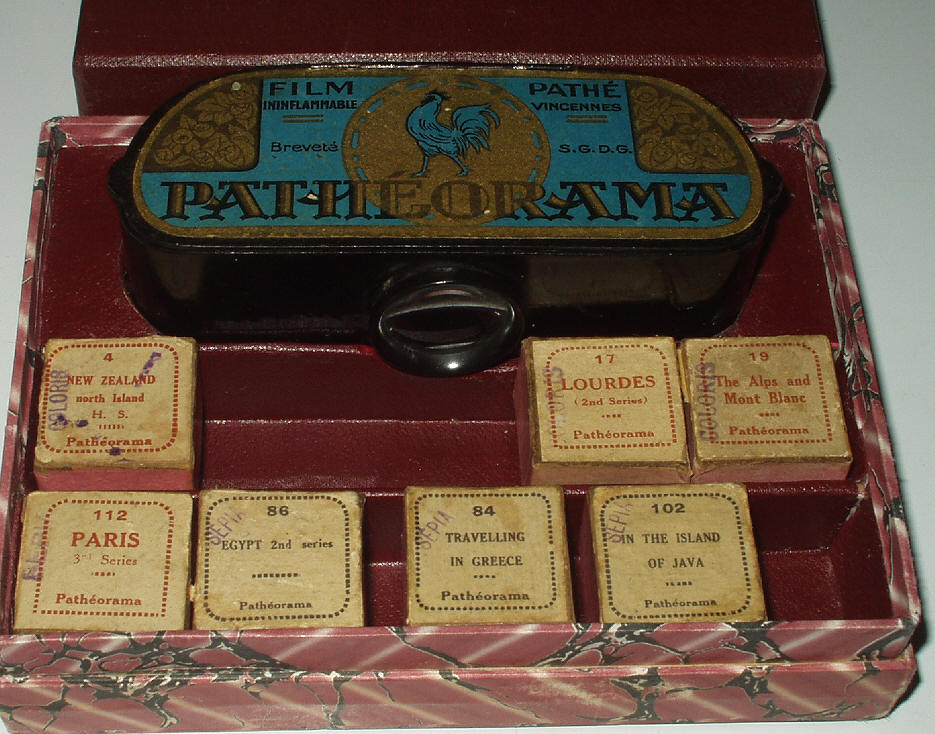
A Pathéorama viewer for the UK market in
presentation box with English titled filmstrips
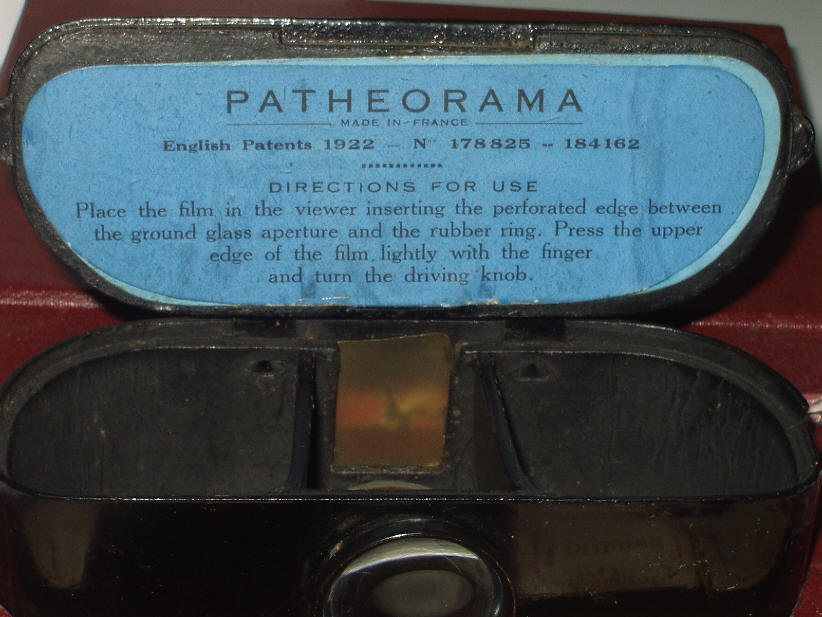
The above viewer with the lid open

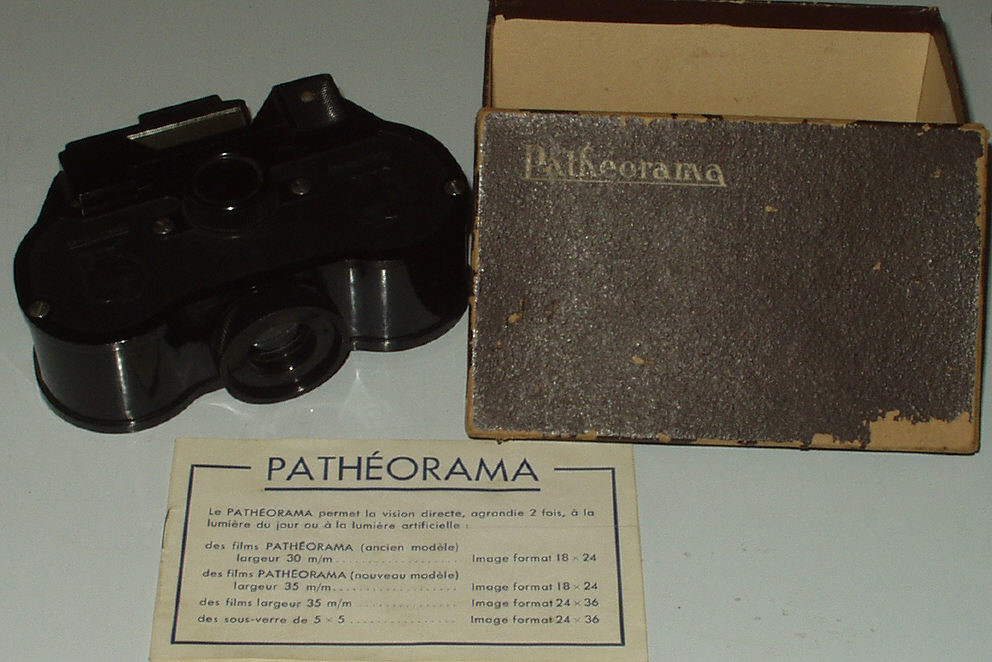
The later (maybe postwar?) bakelite Pathéorama viewer, now
taking full size 35mm filmstrips and even 5 x 5 slides
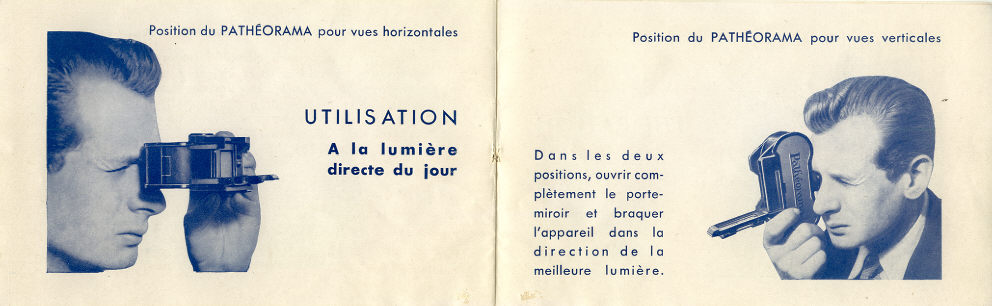
A page of the later bakelite Pathéorama instruction booklet
Sometime later, the Pathéorama viewer was re-introduced; nicely finished in black bakelite it had an adjustable mirror at the back to get the best lighting; the original 30mm (one edge of perforations trimmed off) and now the normal 35mm filmstrips could be used, but also what we now know as 35mm colour slides - 5 x 5 slides. Judging by the photos in the instruction booklet (sadly undated) I would guess this gadget is definitely post-war, probably from the 1950s or so.
Advert in the August/September 1932 "Le Cinema
Chez Soi" Pathé-Baby house magazine
THE PATHÉORAMA (1923)
- (This little article is translated from a French book)
------------------------------
The idea of the Pathéorama derives a little from the middle class kitchen; the art of adapting the left-overs! The principle was to edit still frames, taken from long since forgotten film releases, and to mount these in order on about a metre of 35mm film (non-flam and with one row of perforations cut off).
It only remained to design a little viewer of pressed card (paper mache), to offer a charming plaything, good value and ... profitable. The viewer sold for 10F and the films 5F. Over the years, as expected from the shrewd methods of the well run house of Pathé, the product was improved. Several versions of the viewer appeared:- after the pressed card box came metal edgings, then Bakelite.
A very simple little projector was launched with this last model, into which one inserted the viewer. As with the Pathé-Baby, the Pathéorama catalogue (about 350 titles) offered news items, a number of documentaries, the inevitable "Life of Jesus", some fairy tales, and several story films of the 1920's, some stencil coloured. Who can guess the hours of escape which were provided by these magic windows for a generation of children?
(Jean-Claude Eyraud; "A Century of Pathé")
Notes:
(In actual fact the little tinplate projector "Cocorico" was also designed to accept the all-metal Pathéorama viewer. The original mains voltage (mostly 110 volts in France), lamp was 50 watts, later models had 100 watt lighting. A better lens was also offered. The post-war Bakelite Pathéorama viewer accepted either the Pathé 30mm filmstrips or the full width 35mm standard filmstrips. It also had variable masking and a mirror to improve light pick-up). - gln
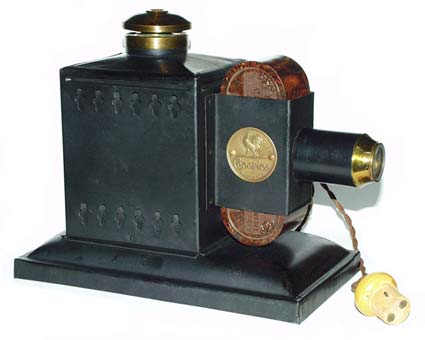 The
Pathé Cocorico projector 1924
With the success of the various types of the
Pathéorama film viewer it was a simple job to design a small
tinplate projector that could accomodate one of the Pathéorama
film viwwers and produce a decent picture. With a type 100b lamp
(maybe 100 watts) these little projectors sold for 150 French
francs or 190 French francs with a superior lens.
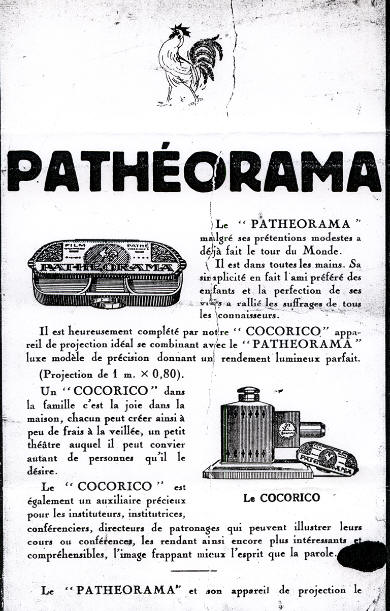
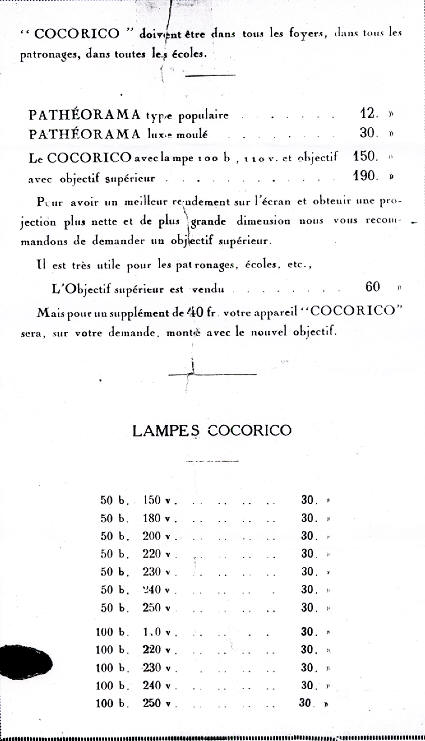
French sales leaflet from possibly the 1920s (courtesy Brian
Giles)
PATHÉORAMA FILMSTRIPS
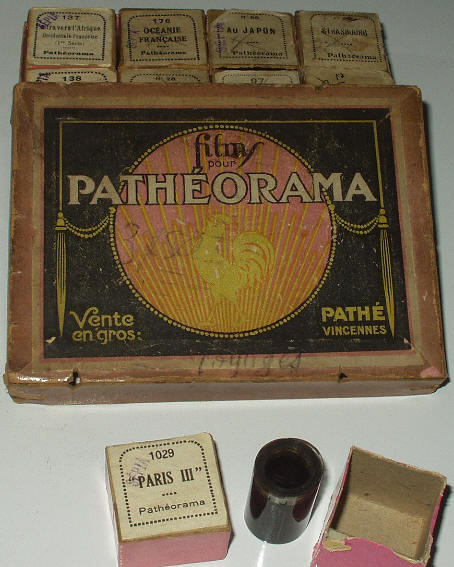
The initial filmstrips were effectively
standard 35mm film but with one edge of perforations cut off -
this unique feature enabled Pathe to patent this format.
The edge of the filmstrips are marked Pathé Cinema Paris Safety
Film. Examples I have checked contain up to about 36 images plus
start titles and a 'Fin' or 'The End'. Later, once the larger
black bakelite Pathéorama filmstrip viewer was introduced this
also accepted standard 35mm filmstrips.
A large number of the Pathéorama filmstrips were issued from perhaps before the first World War. Most of the titles I have in my collection have French titles - I wonder if these were sometime marketed in the UK and even other English speaking countries, certainly so far I have a number of these titled in English. Naturally with a huge back catalogue of 35mm movie films, it was easy for Pathé to recyle all this footage, making up many travel, interest and cartoon type film strips. I guess the travel filmstrips would be an ideal product for the tourist industry - with cruises becoming the fashion for the upper classes in the 1920s onwards, no doubt the rich could return with a viewer (maybe also a projector) and a smart little box of souvenir filmstrips.
Below is the beginnings of a complete list of these titles:- Black & White titles were 4 French francs and Stencil Colour titles were 5.50 French francs,
Ref Number Filmstrip Title Language Type
       02          CHATEAUX DE LA LOIRE                        French   Colour
       04          NEW ZEALAND - NORTH ISLAND                  English  Colour  *
       04          PARIS                                                Colour
       05          PARIS (2e serie)                                     Colour
       06          NICE                                        French   Sepia   *
       16          LOURDES                                              Colour
       17          LOURDES (2nd series)                        English  Colour  *
       19          ALPS AND MONT BLANC (THE)                   English  Color   *
       28          LE MONT ST MICHEL                           French   Sepia   *
       30          VENISE                                      French   Sepia
       46          EN HOLLAND                                  French   Colour
       47          VISITE AUX JARDIN ZOOLOGIQUE (LES ANIMEAUX) French   Colour
       54          LA CORSE                                             Colour  *
       56          LA BRETAGNE (1re serie)                     French   Colour
       56          LA BRETAGNE (2e serie)                      French   Colour
       56          LA BRETAGNE (3e serie)                      French   Colour
       58          VISITE AUX JARDIN ZOOLOGIQUE (LES OISEAUX)  French   Sepia
       69          STRASBOURG                                           Colour *
       84          TRAVELLING IN GREECE                        English  B/W    *
       86          EGYPT (2nd series)                          English  B/W    *
       88          AU JAPON                                    French   B/W    *
       97          ERUPTION DE L'ETNA                          French   B/W    *
      102          IN THE ISLAND OF JAVA                       English  B/W    *
      105          AUX PAYS NORMAND                            French   Colour
      112          PARIS (3rd series)                          English  B/W    *
      119          LA PERTE D'UN SOUS-MARIN                    French   Blue
      137          A TRAVERS L'AFRIQUE OCCIDENTALE TRANCAISE   French   B/W    *
      138          A TRAVERS L'AFRIQUE OCCIDENTALE TRANCAISE-2 French   B/W    *
      139          A TRAVERS L'AFRIQUE OCCIDENTALE TRANCAISE-3 French   B/W    *
      149          CHASSE A LA BALEINE ET AU DAUPHIN           French   Blue
      176          OCEANIE FRANÇAISE                           French   B/W    *
      180          LA SAONE JOLIE                              French   Colour
      1015         LE BLé (1re partie)                         French   Sepia
      1016         LE BLÉ (2e partie)                          French   Sepia
      1029         PARIS 111                                   French   Sepia  *
      1030         LES PYRENEES                                French   Colour
      1031         LES PYRENEES                                French   Colour
      1041         LE MONT MICHEL                              French   Colour
      1048         A TRAVERS LES LANDES DE GASGOINE            French   Colour
      1049         AU PAYS BASQUE                              French   Colour
      1053         ASCENSION MONT-BLANC                        French   Colour
 Notes - where colour is listed, these filmstrips were produced using the Pathé Stencil Colour process
       - many of the little boxes are marked Sepia, but most of mine are actually B/W (black & white)
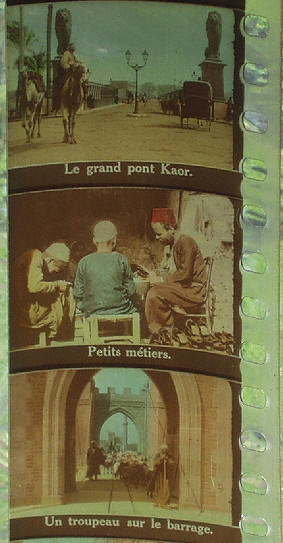
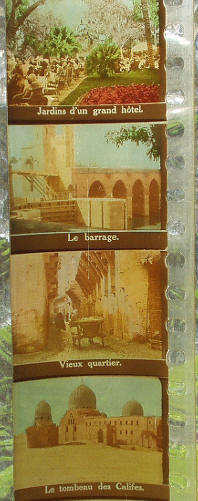
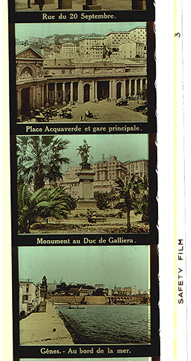
Pathéorama filmstrip clips - Pathé Stencil Colour - the
first two from "En Egypte"
Return to: PATHE MENU ................ or return to: MAIN MENU
Created 04Apr2015 ............. Last updated: 26 September 2019
...............pathe/patheorama.htm ................. © MMXV
G.L. Newnham
28Apr2015 - Jean-Claude Eyraud article translation added /
26Sep2019 - Patheorama & Cocorico 1924 advert added