Grahame N's Web Pages
T.9003 (6 reel 9.5mm sound release by Pathéscope November 1940)
 "SCROOGE"                          GB Nov1935     Dir: Henry Edwards
 -----------
78mins B/W Cert "U"                  Produced by: Julius Hagen Productions
(Approx 50mins on 9.5mm)             Released by: Twickenham Film Distributors Ltd.
Produced at Twickenham Film Studios, Twickenham, Middlesex, UK
Screenplay by: Charles Dickens (original 1843 novel) and H. Fowler Mear
Production Supervisor: Hans (John) Brahm
Photography: Sydney Blythe, William Luff
Art Director: James A. Carter
Supervising Editor: Jack Harris      Film Editor: Ralph Kemplen
Music by: W.L Trytel
Assistant Direction: Arthur Barnes, James Davidson
Cast: Seymour Hicks ........... Ebenezer Scrooge
Donald Calthrop ....,.... Bob Cratchit
Robert Cochran .......... Nephew Fred
Mary Glynne ............. Belle
Garry Marsh ............. Belle's Husband
Oscar Asche ............. Spirit of Christmas Present
Marie Ney ............... Spirit of Christmas Past
C.V. France ............. Spirit of Christmas Future
Athene Seyler ........... Scrooge's Charwoman
Maurice Evans ........... Poor Man
Mary Lawson ............. Poor Man's Wife
Barbara Everest ......... Bob Cratchit's Wife
Eve Grey ................ Fred's Wife Eve Gray
Morris Harvey ........... Poulterer with Prize Turkey
Philip Frost ............ Tiny Tim
D.J. Williams ........... Undertaker
Margaret Yarde .......... Scrooge's Laundress
Hugh E. Wright .......... Old Joe
Charles Carson .......... Middlemark
Hubert Harben ........... Worthington
Robert Morley ........... Rich Man (uncredited)
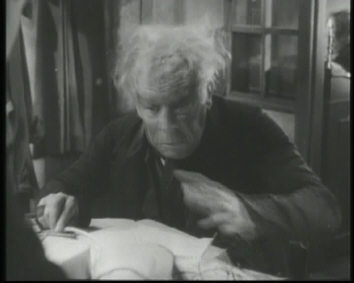 Seymour Hicks
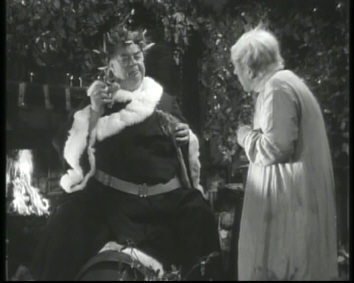 Oscar Asche
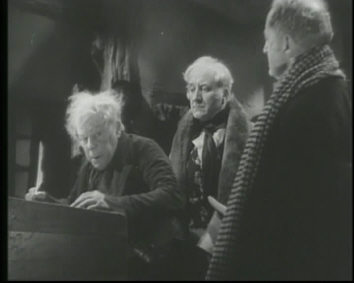
In 1843 Victorian England, stingy and cranky Ebenezer Scrooge does not care for
Christmas and runs his business exploiting his employee Bob Cratchit and clients.
On Christmas Eve, he is visited by the ghost of his former partner Jacob Marley who
tells him that three spirits will visit him that night. The first one, the spirit of
Christmas Past, recalls his miserable youth when he lost his only love due to his greed;
the spirit of Christmas Present shows him the poor situation of Bob's family & Tiny Tim
and how joyful life might be; and the spirit of Christmas Future shows his fate.
Scrooge finds life is good, time is too short and suddenly you are not there anymore,
changing his behavior toward Christmas, Bob, his nephew Fred, and people in general.
(International Movie Database)
I love it! We watched it again this year. The Bob Cratchit character is one of the most kindly ever, you really feel sorry for him. It was an honour to see Seymour Hicks play Scrooge as he was a veteran of the very early silent version in 1913 (IMDb)
Scrooge is a 1935 British fantasy film directed by Henry Edwards and starring Seymour Hicks, Donald Calthrop and Robert Cochran. Hicks appears as Ebenezer Scrooge, the miser who hates Christmas. It was the first sound version of the Charles Dickens classic novel A Christmas Carol, not counting a 1928 short subject that now appears to be lost. Hicks had previously played the role of Scrooge on the stage many times beginning in 1901, and again in a 1913 British silent film version (Wikipedia)

World War 11 - so only a single sheet
for this Pathéscope Monthly when "Scrooge" was
released on 9.5mm sound
- this 9.5mm optical sound release continued in the Pathéscope
catalogues till 1952.
 by Maurice Trace
Seymour Hicks was a celebrated actor, author, playwright, composer, theatre manager and producer.An extrovert, he led a colourful life, mixing with Royalty and other notables such as Oscar Wilde, W.S. Gilbert and Henry Irving. Festooned with honours and popular acclaim, he was knighted in 1935, twice awarded the Cross de Guerre and also won the Legion of Honour. Hicks was an accomplished performer in films and three of his movies were released by Pathéscope. ("Secret of the Loch"; "Scrooge" and "It's You I Want") He often appeared on stage with his wife Ellaline Terriss and the pair were regarded as a show business "golden couple". Her father was the popular leading man William Terriss who was murdered outside the stage door of the Adelphi Theatre by a deranged actor.
Seymour was born at the end of January 1871 in Jersey (UK), which he described as "an island full of poor ladies and gentlemen". Following a short spell as a wine-merchant's clerk in London, he took to the stage at the age of sixteen. His first role was as an extra at the Grand in Islington where the prompter was a youth who later became the renowned A.E. Mathews. Seymour quickly rose to fame as an actor and also began to write light musicals in which he later starred. He worked with impresario George Edwardes, whose life formed the basis of the 1946 film "Gaiety George", which is on 9.5mm sound. Edwardes is credited with inventing the modern musical comedy, but Hicks later wrote that it was doubtful if George could tell the difference between "Abide With Me" and The National Anthem!
The musicals were a great success and financially very rewarding. One called "Beauty Of the Bath", had additional lyrics written by an unknown gentleman called P.G. Wodehouse and extra music from a promising musician named Jerome Kern. With his fortune, Seymour built two London theatres - the Aldwych in 1905 and a year later, the "Hicks" which is now "The Guilgud". He also branched out to play major dramatic roles such as Shakespeare's Richard 111 and Charles Dicken's Ebenezer Scrooge.
Hicks also saw possibilities in the growing Cinema Industry. He made his first film in 1907, a short called "Seymour Hicks Edits The Tatler". In 1922 he worked on a two reel comedy called "Always Tell Your Wife". Seymour starred, produced and the plot came from one of his plays. shooting did not run smoothly and director Hugh Croise was sacked. To take his place Hicks brought in the studio property master - a young man called Alfred Hitchcock.
In 1934 Seymour appeared in "Secret Of The Loch", a film which has spoilt ninefivers. Pathéscope released the movie in full on 17.5mm sound and on 9.5mm as a sound six-reeler, a three reel silent and a 100ft sound clip under the title "Monsters". (plus a 60ft silent short "After the Monster" - gln) The names of the people involved are impressive. The screenplay came from Charles Bennett, one of Hitchcock's top writers ("Blackmail"; "The 39 Steps" etc), a young David Lean was the editor and the cast included Gibson Gowland, star of Eric Von Stroheim's classic "Greed". The plot centres on the Loch Ness Monster which was all the rage at the time.
The opening is impressive as a man runs
through the countryside in the middle of the night. He bursts
into an inn and claims to have seen the Beast. Professor Heggie
(Hicks) enters and eloquently delivers a sombre speech about the
mystery of the loch. This is a superb sequence, but alas the rest
of the film is an uneasy mixture of thriller, comedy and horror
movie. Some of the scenes are played for broad farce, whilst
others are effective chillers. The weak hero (Frederick Peisley)
is an irritant, and when it finally appeared, the monster was a
big dissapointment. It turned out to be an actual living reptile
magnified to a huge size. Also Hick's performance lapses into
caricature with director Milton Rosmer unable to control the
great man. Rosmer had been an actor in the Silents with a style
often referred to as "ham". He must have approved of
his star's excesses!!
.......................................................... (Reviews
of his other 9.5mm films are omitted here)
............................
Seymour continued working in both cinema and theatre up to his
death in 1949. His final film was "Silent Dust"
in which he played Lord Clandon. Fittingly the role of Lady
Clandon was taken by Marie Lohr, his co-star from "It's
You I Want". Seymour Hicks came from a world long gone.
His splendid book "Vintage Years" (1943) about life in
London before the turn of the century ("the naughty
nineties") is a fine read. The publisher commented it was
"as though a century or more had intervened". Ellaline
passed away in 1971 at the age of 100 and so ended a magic era.
(slightly edited from an excellent Maurice Trace article published in the Group 9.5 magazine no.138 - Summer 2009)
Because
this film is 'public domain' |
Meantime watch the complete full-length film on You Tube: "Scrooge" 
Notes:
  1. This was the second time Seymour Hicks had portrayed Ebenezer Scrooge on film.
     The first was in "Scrooge" (1913) which was released in 1913, 22 years earlier.

  2. This is the only major film version of the story in which Marley's Ghost is not
     listed at all in the credits, even though his voice is heard in the picture.
     (He is never actually seen in this version, except on the door knocker).

  3. Twickenham ran a 'showmanship competition' to find the cinema manager who did best
     publicity for this film. £10 top prize went to Harry Yorke of the Odeon, Brighton.

  4  Henry Edwards had been a Matinee Idol in the British Silent Cinema - he can be seen
     as the hero in "The Further Adventures Of A Flag Lieutenant" (1928) which Pathéscope
     released on 9.5mm silent. Henry becamre a director in the Thirties, but returned to
     acting a decade later. Eve Grey also appeared as Eve Gray.

  5. Pathéscope cut a lengthy sequence early in the film of a lavish banquet hosted by
     the Lord Mayor of London. This opulent occassion as the rich dined in style was
     contrasted with the hungry poor in the streets and Scrooge consuming his usual
     sparse evening meal in a dingy tavern.  Also omitted were some opening scenes in
     the office between Scrooge and Bob Cratchit, a section of the Nephew's Christmas
     Party and the section with the Rag Pickers sorting out the deceased clothes.

  6. At the end of 1935, President Franklin D. Roosevelt requested Paramount Pictures,
     the American distributors, to show the film to his family and friends at the White
     House on Christmas Night. Later producer Julius Hagen alleged that Paramount ordered
     140 prints for the USA market, but then claimed they arrived too late for release
     over the lucrative Christmas period. Hagen said he had been promised £40,000 from
     the film's American sales, but received only £1,200.

  7. Seymour Hicks played the miser part over two thousand times on stage, starting in
     1901 at the Vaudeville Theatre. In 1913 he took the lead in "Scrooge", a silent film
     directed by Leedham Bantock. In this 1935 version, most of the Ghosts are not shown
     clearly on screen, although their voices can be heard. The Ghost of Christmas Yet To
     Come appears as a dark outstretched pointing finger and the Ghost of Christmas Past
     is a luminous blur. (Actress Marie Ney provided the physical outline, but the voice
     was that of an unnamed actor). Only the Ghost of Christmas Present
     (played by Oscar Asche) is visible.

  8. The 9.5mm sound print seems to have been deleted around 1952, being included in the
     1952 illustrated film catalogue, but not later ones.
  9. Ralph Kemplen, the film editor on this movie, would also edit another Charles Dickens
     film 33 years later - the musical Oliver! (1968), based on "Oliver Twist".
 10. When Scrooge is getting home from the pub on Christmas Eve, a white bucket drops at
     his feet, missing his head by inches. Unfazed by the goof, Scrooge kicks it out of
     the shot making it seem like it was intentional, but it is clearly a post-Victorian
     era plastic bucket.
 11. There is another article by Maurice Trace about "Scrooge" in the Group 9.5 magazine
     No.64 Winter 1990/1991.
(Extra Info gratefully sourced from Maurice Trace and Wikipedia)
Return to: 9.5MM PATHESCOPE SOUND FILM CATALOGUE ........... ALPHA .......... NUMERIC
Created 16Nov2015 ...... Last updated: 18 December 2019 ......
95flmcatt9003.htm ...... ©MMXV Grahame L. Newnham
04Dec2014 - excellent Maurice Trace article on Seymour Hicks
added
18Dec2019 - YouTube link added